
What if borrowing or renting were as easy as buying? We buy and own countless products that we use only occasionally. This pattern has a cost: more resources are extracted, more products are manufactured, and many of them remain largely underused.
But alternatives to ownership are already here. Tool libraries. Rental businesses. Sharing initiatives, social enterprises, and peer-to-peer services – all giving people access to what they need, exactly when they need it.
The problem? These services are often fragmented, hard to find, or simply not visible enough. More fundamentally, they rarely form a coherent local ecosystem.
Access Hubs is exploring – and testing – how cities can change that.
Funded by the European Union through the Interreg North-West Europe programme, Access Hubs brings together 12 partners from six countries, including cities, circular economy organisations, innovation actors and research institutions.
The project runs from January 2026 to June 2029. Its ambition is to make borrowing, renting and, sharing of household goods more accessible, affordable and convenient, while helping cities create the conditions for these services to thrive over the long term.
IÉSEG’s contribution: understanding what makes access ecosystems work
Within Access Hubs, IÉSEG helps build the evidence needed to understand, design and evaluate local access ecosystems.
Its research connects citizen behaviour, business models, governance and impact assessment with the practical challenges faced by participating cities.
Work Package #1:
Building a common access economy vision
> What makes a local access ecosystem work for citizens and municipalities?
IÉSEG’s contribution:
Study citizen adoption and barriers to borrowing, renting and sharing; explore the role municipalities can play; contribute to practical tools and evidence for local access-economy planning.
Work Package #2:
Making access services visible
> Which platform and governance models can support a successful local Access Hub?
IÉSEG’s contribution:
Analyse access platforms, business and governance models, and public-private collaboration; support municipalities in preparing local pilots; develop a framework to assess social, economic and environmental impacts.
From research to experimentation
Research is directly connected to implementation.
Seven local Access Hubs will be tested in Amsterdam, The Hague, Ghent, Dortmund, Béthune, Valenciennes and Dublin.
These pilots will test different platform, business and partnership models in real municipal contexts and generate evidence on what works, where and under which conditions.
A continuous learning cycle: Understand → Compare → Design → Test → Evaluate → Replicate
Lessons from the seven pilots will feed into a transnational implementation guide covering governance, business models, stakeholder collaboration, data interoperability and performance measurement.
The goal is to make this knowledge reusable by other cities and organisations and to help embed the access economy into local and regional policies across North-West Europe.
Access Hubs in numbers
- By the end of the project, the seven pilots aim collectively to:
- Aggregate at least 140 access-based services
- Engage 10,000 end-users
- Facilitate 12,000 transactions
Access Hubs therefore goes beyond testing a digital platform.
It explores how cities can make accessing goods instead of owning them a realistic, convenient and scalable alternative.
A European consortium
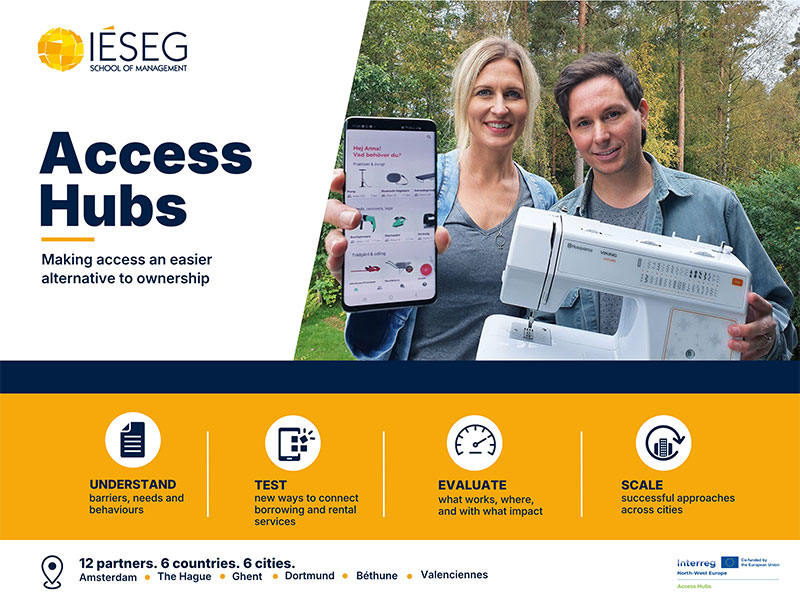
Access Hubs brings together 12 partners from 6 European countries, combining municipalities, research institutions, circular economy organisations and innovation partners.
- Belgium: The Kringwinkel Antwerp (Lead Partner), City of Ghent, Made by Rombit
- France: IÉSEG School of Management, Community of Agglomeration Béthune-Bruay Artois Lys Romane, Community of Agglomeration Valenciennes Metropolis, We Right Click
- Germany: Economic Development Agency of the City of Dortmund
- Ireland: The Rediscovery Centre
- Luxembourg: University of Luxembourg
- The Netherlands: City of Amsterdam, Municipality of The Hague
Meet the IÉSEG team

Sébastien BOURDIN
Principal Investigator, Full Professor of Environmental Management


More information about the Access Hubs project
The project is funded by the EU under the Interreg North West Europe program.
The total amount of funding provided by the European Union for this project is €2,987,641.42. The total project budget is €4,979,402.40, with an additional €1,991,760.98 provided through co-financing from the project partners.
Learn more about the Interreg North West Europe program: https://ah.nweurope.eu/.