OVICTY’s inspiring journey between a consulting career and arts
A 2020 graduate of IÉSEG, Victor MOITY, who works under the artist name OVICTY, splits his time between digital transformation consulting at Wavestone and his rapidly growing artistic practice.
A skateboarder, self-taught cartographer and collage artist, OVICTY has developed a distinctive visual language across a range of media. His work is deeply shaped by a life-changing experience: at 19, he survived a sudden and severe case of meningitis that left him in a coma for a week and permanently altered the way he approaches both life and creation.
Today, he speaks about resilience, curiosity and balance—about learning to live with two careers, two different rhythms and two passions, but also about the role IÉSEG played in giving him the freedom to explore, experiment and evolve.
You joined IÉSEG in 2013 at the age of 18—what happened next changed your entire life.
I joined IÉSEG in 2013, on the Lille campus. My path could have been just an ordinary one, but early in my second year, everything turned upside down. I contracted a severe case of meningitis, was saved at the last minute by my mother, spent a week in a coma and needed nearly a year to recover. It felt like a second birth. It reshaped the way I see life—and, later on, the way I approach my work as an artist.
What I remember mostly is how the School adapted to my situation. They allowed me to spread my second year of studies over two years. I ended up belonging to two different cohorts, which exposed me to very different people and dynamics.
I’ve always loved creating—DIY projects, video editing, sculpting. I never focused on a single discipline; I enjoyed experimenting many different things. IÉSEG offered that same freedom academically: discovering many subjects, sometimes quickly through electives, sometimes in depth through core courses. Even a “first layer” of knowledge matters—it often sparks the desire to return and explore further. This holds true both in my artistic and professional life: you can’t invent what you don’t know, but you can enrich even the briefest exposure to an idea.
How did your artistic approach take shape?
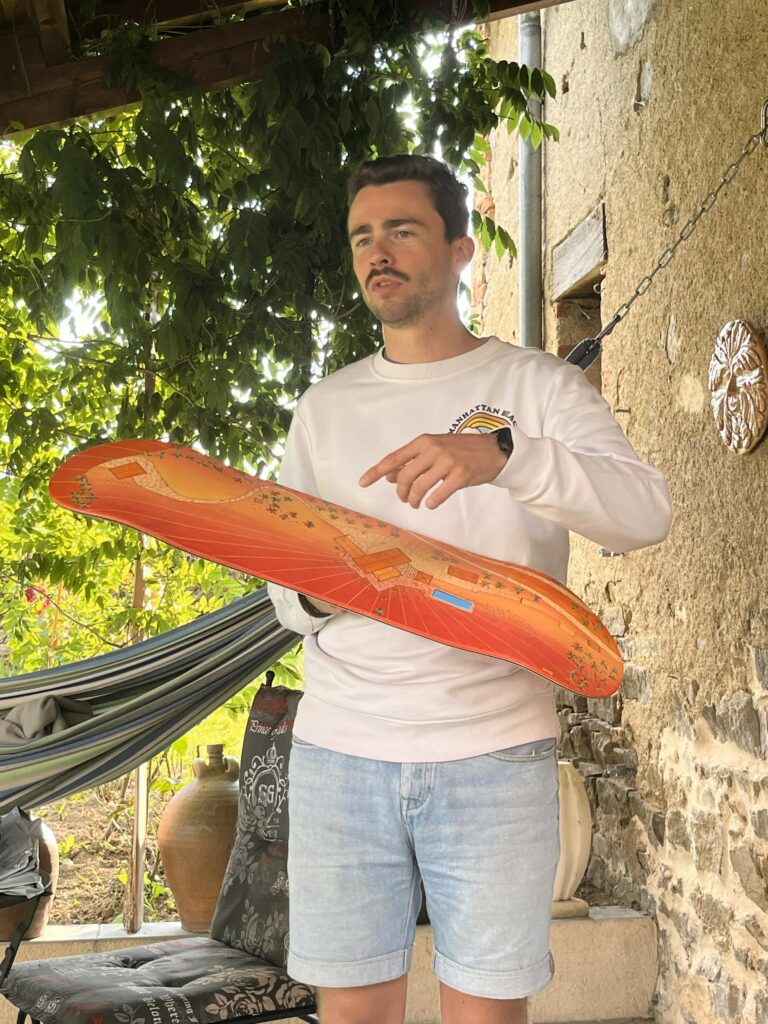
It all started with skateboarding. I’ve always been a skater, and I went through boards quickly. Since I struggle to throw things away, instead of discarding them, I began drawing on them—using spray paint and other techniques, very instinctively. I then moved on to collage, particularly using comic books. I’m a huge fan of Hergé, so my first collages were made from Tintin albums. They allowed me to cover large surfaces while paying tribute to artists I admire.
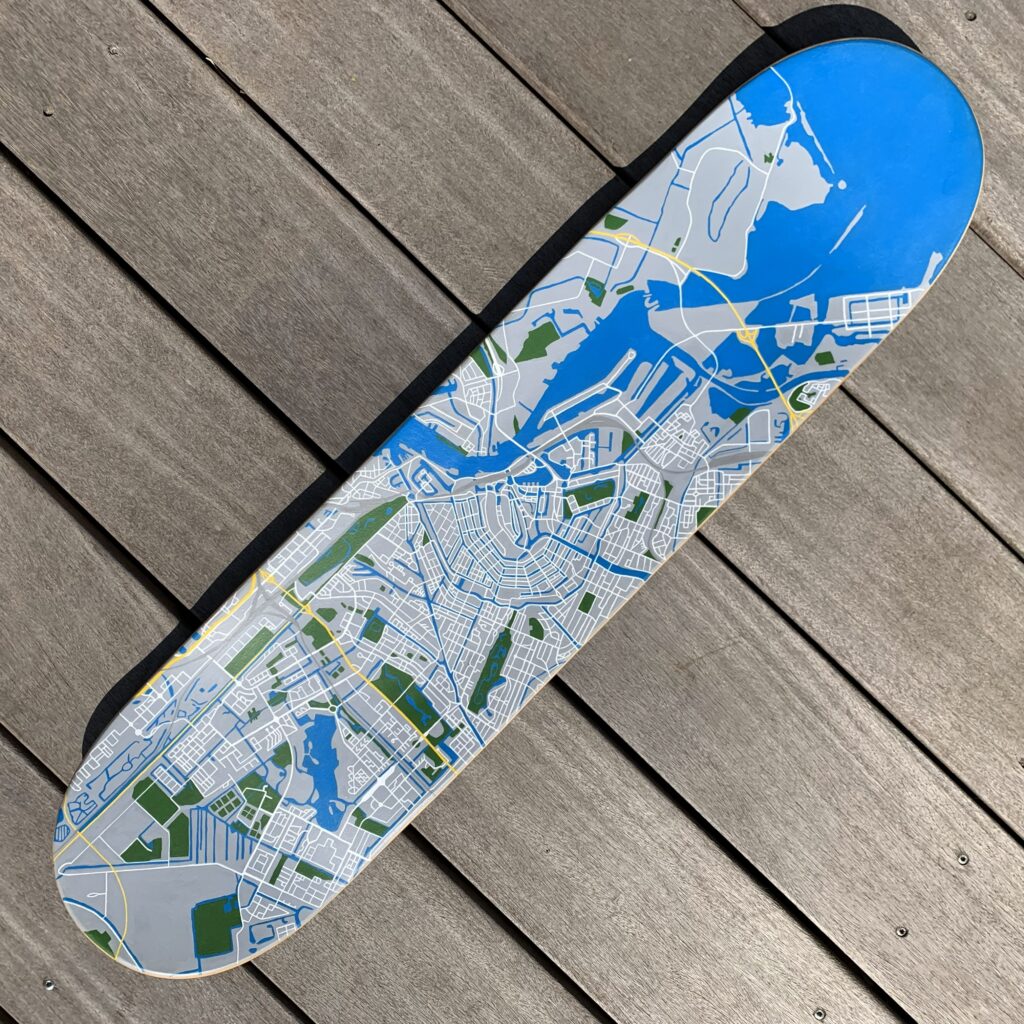
During an internship in Amsterdam, I fell in love with the city. Its cartography fascinated me—the blend of urban space, water and greenery, the interwoven canal structure. I began my first map without realizing it would become my most time-consuming piece: over ten months of work. It pushed me beyond my usual habits and forced me to develop new creative processes. When it was finished, I was amazed by the result—it was the first time I truly felt I had created a work of art.
That experience led me to create a map of Lille, centered around the Quai du Wault, in a completely different style. It was a far more personal piece, as it reflected where I lived after my illness and allowed me to express deeper emotions. Other maps, in various styles, followed. I then began selling my work—an important milestone in my artistic journey.
Because each piece takes between 30 and 40 hours to complete, I wanted to reach more people than a single buyer. I turned to digital formats to adapt my visuals into posters and prints, expanding their reach. Always with the same mindset: exploring new approaches, integrating new techniques, and constantly renewing my practice.
Why combine a career in consulting with a career as an artist?
During my years at IÉSEG, I joined the Junior Enterprise and really enjoyed my first exposure to consulting. After completing a Master’s degree in Information Systems Management, I joined Wavestone, a firm specializing in digital transformation—first as an intern, then as a full-time consultant.
At the same time, my artistic practice was gaining momentum. My weeks were intense, and I constantly felt torn between art, professional commitments and personal relationships—an exhausting balancing act. On top of that came a persistent sense of FOMO: whenever I chose one thing, I felt I was sacrificing another. I didn’t want to give up either my artistic ambitions or my personal life, and everything became a matter of choice.
After three years working full-time—and following a long period of reflection and doubt—I discussed the situation with my managers and was fortunate that the company agreed to a part-time arrangement. It was a smooth process, thanks to clear and transparent communication, the non-competitive nature of my artistic activity, and—perhaps most importantly—the trust I had built by remaining deeply committed and positive at work.
I initially dedicated one day a week to art, which felt like a breath of fresh air. Today, the company allows me two days a week. On those days, I disconnect completely and work in a focused, immersive bubble.
What skills do art and consulting have in common?
More than one might think. First, project management: both require organization, planning and structure. Then there’s the entrepreneurial dimension. Creating an artwork isn’t enough—you need a legal status, administrative management, buyers, exhibitions, social media visibility. My practice is artistic, but I manage its strategic and operational aspects with an entrepreneurial mindset.
Versatility is another shared skill: switching between topics, prioritizing, juggling multiple activities—something central to consulting and increasingly present in my artistic life.
Finally, learning in unfamiliar environments. I have no formal artistic training and initially knew neither the codes nor the networks of the art world. Like entering a new company as a consultant, you have to take the leap, trust your instincts and learn step by step. This mindset allows me to approach my artistic life with confidence, without being overwhelmed by imposter syndrome.
Does art help you in your work as a consultant?
Absolutely. Art brings breathing space and serenity. I used to feel intense stress over even minor project delays. Having two professional lives now gives me perspective and prevents me from being consumed by corporate pressure.
Art helps me maintain a healthy distance and a lighter outlook. I’m emotionally very receptive—I absorb a lot—so that space is essential. I build my way of thinking from all my experiences; it’s a whole.
Art helps me maintain a healthy distance and a lighter outlook. I’m emotionally very receptive—I absorb a lot—so that space is essential. I build my way of thinking from all my experiences; it’s a whole.
How did IÉSEG contribute to your growth in both spheres?
IÉSEG taught me curiosity, openness and the ability to explore many fields. Every course, elective or project opens a door you can revisit later. In art, versatility is essential—marketing, negotiation, finance, management. Without a patron, you must master everything yourself. The School prepared me extremely well for that reality.
What does an artistic life represent for you on a daily basis?
It’s about following instinct. We all have dreams, but the difference between those who realize them and those who don’t is taking that first, difficult step—and persevering over time. Doubt and loss of motivation are inevitable; that’s life. In those moments, I reconnect with what matters most: why I chose this artistic life, what it brings me, and how it helps me grow. I try to preserve my childlike curiosity—it guides me every day. I’m very proud of the balance I’ve built.
Today, I feel fulfilled in what I do, which is already a huge privilege. Art is also a powerful means of connection; it has taken me beyond my daily routine and enabled me to collaborate on a deeply meaningful project with IÉSEG.
A piece of advice for students and young graduates?
Open yourself to the world! As an artist, I draw inspiration from everything I see, discover and from the people I meet—and I try to apply that outlook to everyday life: staying curious, keeping your eyes open, allowing yourself to be amazed. Thanks to IÉSEG, I explored countless subjects, met extraordinary people and created many opportunities. Every new topic and every encounter forms a connection in the mind—and each connection opens a door.
And above all: dare to start. Nothing exists without a first step. Every artwork, project or company started with a small action. It’s consistency—showing up day after day—that turns those first gestures into something real. If you dream of becoming an artist, remember: there is art, but there is also reality. Without promotion and business skills, it’s impossible to make a living. Even artists must master marketing, finance and negotiation. IÉSEG is an exceptional environment for developing those skills.
An original map celebrating IÉSEG’s dual-campus identity: “One School, Two Campuses”
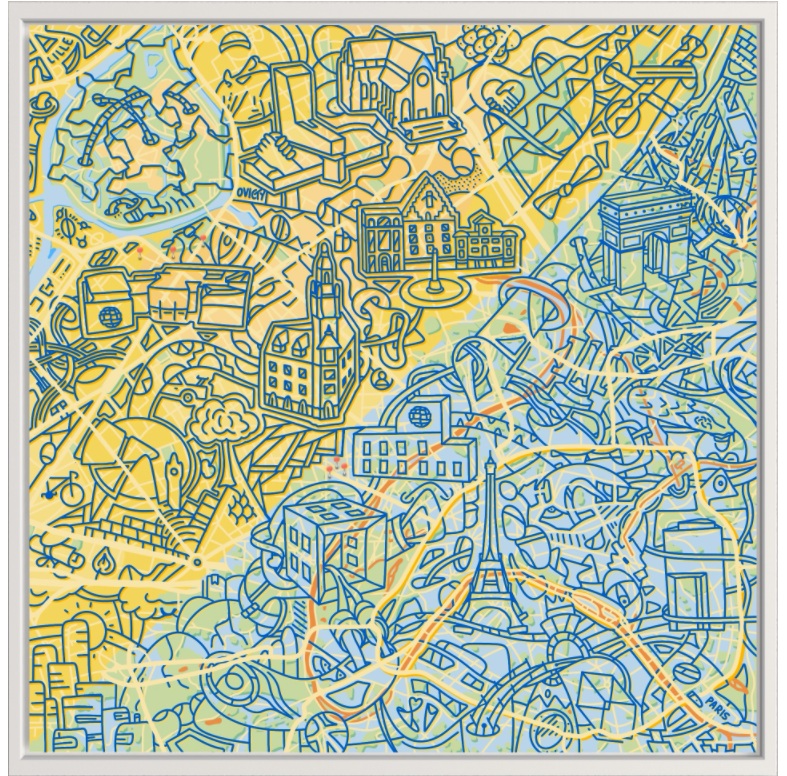
IÉSEG commissioned OVICTY, an alumnus of the School, to create an original artwork: a map merging the environments of its two campuses—Lille and Paris–La Défense—to symbolize its unique identity: “One School, Two Campuses.” The project took the form of a premium poster, printed in a limited edition of 200 signed and numbered copies, intended for the School’s partners.
“When the School approached me, I immediately saw the opportunity to create a premium item that embodied both IÉSEG’s identity and my creative universe. From our first discussions, we envisioned the poster as an artistic cartography—representing both campuses within a single visual composition through layers and symbols that highlight the School’s uniqueness.
My goal was to design a compact yet airy piece, blending geometric shapes, curves, figures and references to both cities. Lille and Paris are represented through their iconic landmarks: the Grand’Place, the Palais de la Bourse, Notre-Dame de la Treille and the Lille campus buildings; the Eiffel Tower, La Défense Arch, the Arc de Triomphe and the Paris campus. Symbols representing the School’s values are subtly hidden throughout the piece. The color palette contrasts yellow for Lille with blue for Paris—the School’s logo colors—emphasizing both duality and complementarity.
Printing this cartography on high-end paper allowed me to capture the energy, diversity and creativity that define IÉSEG. I sought to balance academic rigor with creative freedom to produce a work that is rich, dynamic and true to the School’s spirit.
This creation reflects the vibrant exchange of ideas, the diversity of talent and the shared energy of the entire IÉSEG community.”