Sexual education in the digital age: Chloé Besson’s thesis wins the 2026 ICOR Prize
Through the ICOR Prize, IÉSEG annually recognizes student research that sheds light on major economic, social, and societal transformations. The 2026 edition is no exception, featuring three finalists whose theses demonstrate strong commitment and a keen analytical eye.
Among them, Océane PEPIN, supervised by Marie REDON, studied the impact of the CSRD (Corporate Sustainability Reporting Directive) on the auditing profession, while Elodie BARTONE, guided by Julie BAYLE-CORDIER, examined perceptions of student well-being in business schools through an integrative model.
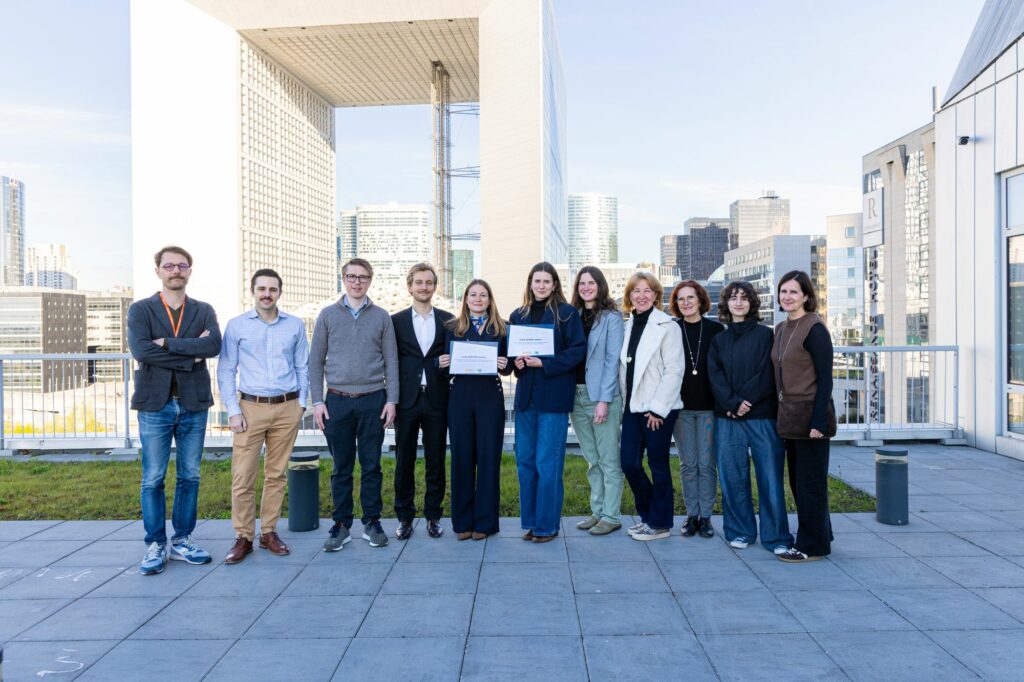
The 2026 ICOR Prize was awarded to Chloé BESSON, supervised by Joanna SERAPHIM, for her thesis titled: “How does technology impact young adults’ access to sexual health and relationship education?”
2026 ICOR Prize
More than research: a personal commitment
Completed as part of a Master in Entrepreneurship, this work stands out for its real-world grounding. As both a student and an entrepreneur, Chloé BESSON is also the founder of the start-up Let’sTalkAboutSex, which aims to promote sexual and emotional health education in student environments.
Her thesis is a direct extension of this mission: Chloé seeks to “better understand the issues facing young people today and analyze the opportunities offered by the current market, particularly in the field of impact innovation.”
She explores essential questions of inclusivity, equality, and accessibility while maintaining a clear-eyed perspective on the role of technology: “Technology can transform access to information, especially for audiences who do not always benefit from a comprehensive education in this field.”
Digital tech: between access catalyst and new vulnerabilities
A major contribution of Chloé BESSON’s thesis lies in its ability to move beyond a purely optimistic view of technology. While digital tools open new perspectives regarding confidentiality, accessibility, and innovation, they also present structural challenges.
She warns against “misinformation, the lack of personal data protection, and the insufficiency of a truly inclusive approach.”
Her study also highlights a key point: technology can only be effective if it complements human support. The health professionals interviewed for the study emphasized the importance of a reliable, contextualized, and person-centered framework.
The growing necessity of regulation
Beyond usage, the thesis questions the responsibility of digital platforms in disseminating sexual health content.
“It is urgent to rethink the regulation of moderation algorithms on social networks,” she explains, pointing out a striking paradox: educational or medical content is sometimes censored, while other, more problematic content continues to circulate.
In this context, she calls for “better protection for victims and the prevention of the normalization of violence, while facilitating access to reliable educational information.”
Consistency in form and Substance
This work is also distinguished by its presentation. Chloé BESSON chose to use inclusive writing throughout her thesis: “A conscious choice to promote equitable and fair representation, in line with the issues being studied.”
Beyond a linguistic preference, this decision reflects a broader commitment to equality, respect, and diversity, consistent with her entrepreneurial project and the themes addressed.
Impact-driven research
In keeping with the values she champions, the winner chose to split her prize money between two committed organizations:Life Project 4 Youth,, which helps young people in situations of extreme poverty transition into the workforce through training and personal development programs, and ONU Femmes France, an organization dedicated to gender equality through advocacy, awareness, and field actions for women’s rights.
Her thesis also opens concrete avenues for educators, health professionals, entrepreneurs, and public policymakers. Specifically, it calls for stronger collaborations to build sexuality education that is better adapted to the digital age.
As she puts it herself, the ambition is clear: to imagine “innovative and inclusive solutions to complex societal issues” and contribute to an education that is “fairer, more inclusive, and accessible for all.”
Finally, Chloé concludes by inviting everyone to adopt “an open mind and a curiosity for the dynamics at play in order to combine innovation, social impact, and equality.”
The ICOR Prize
The ICOR Prize annually rewards student research distinguished by academic excellence, originality, and contribution to major contemporary issues in the fields of responsibility, ethics, and sustainability.
Open to all disciplines, it highlights projects capable of bridging the gap between research and impact, valuing approaches that are rigorous, innovative, and socially engaged.
Through this prize, IÉSEG reaffirms its commitment to training students capable of understanding and actively contributing to world transformations.