
The AI Battle: a card game designed to think about AI differently
10/09/2026


What if learning to decode artificial intelligence was as simple as playing a card game? During orientation week, IÉSEG turned to an innovative educational tool to address complex topics surrounding generative AI. Developed by the non-profit organizations Latitudes and Data for Good, this collaborative card game—titled The AI Battle (“La Bataille de l’IA“)—helps guide students in navigating their relationship with these rapidly expanding technologies. The pedagogical objective isn’t teaching students how to use these tools, but rather fostering critical thinking and a reflective mindset toward generative AI. It offers a learning experience that is playful, collaborative, and distinctly human.
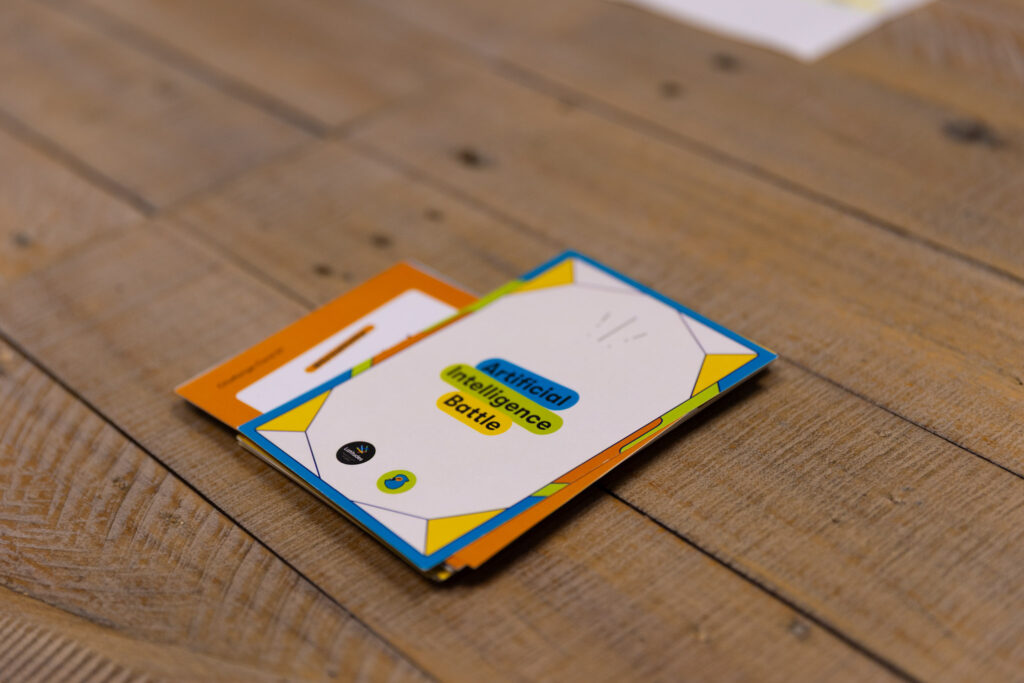
A timeline, a debate, and a scenario: three steps to achieve one goal
The first phase centers on a interactive timeline, allowing students to map out and (re)learn key milestones in the history of artificial intelligence, and reflect on just how rapidly development has accelerated.
The second phase dives into the ethical and societal issues surrounding generative AI. Built around five major themes—information reliability, data bias, creativity and copyright, environmental impact, and social consequences—students draw question cards and debate them in groups. Each card prompts students to question these topics, backed by verified facts on the back of the cards to fuel discussions. The goal is to shift the conversation from “How does it work?” to “What are the implications?”, while developing argumentation and active listening skills.
“What makes this activity so exciting is the richness of the discussions. Everyone shares their perspective, and there are no right or wrong answers, so students feel comfortable participating. The real goal is to debate, build arguments, and develop active listening skills. We find that students are more than willing to get involved. In fact, I would even say they love the exercise,” explains Sandrine DELCOURT, Multimodal Learning Engineer at IÉSEG’s Center for Educational and Technological Innovation (CETI).
Finally, the third phase introduces prospective scenarios. Students take on specific roles such as school director, parent, teacher, student, or corporate representative to debate real-world situations. Should textbooks be written with AI? How can businesses use it without stifling human innovation? These role-playing scenarios help move past generalities and bring contrasting perspectives together within a supportive environment that taps into both imagination and critical thinking.
“We step away from the digital sphere so that students can gain complete perspective, particularly thanks to the human side of the game: talking, discussing, and debating a 100% digital topic, without digital tools,” adds Sandrine DELCOURT.
The game naturally fosters soft skills like communication, empathy, and critical thinking, all while instilling solid knowledge on a highly complex, contemporary topic.
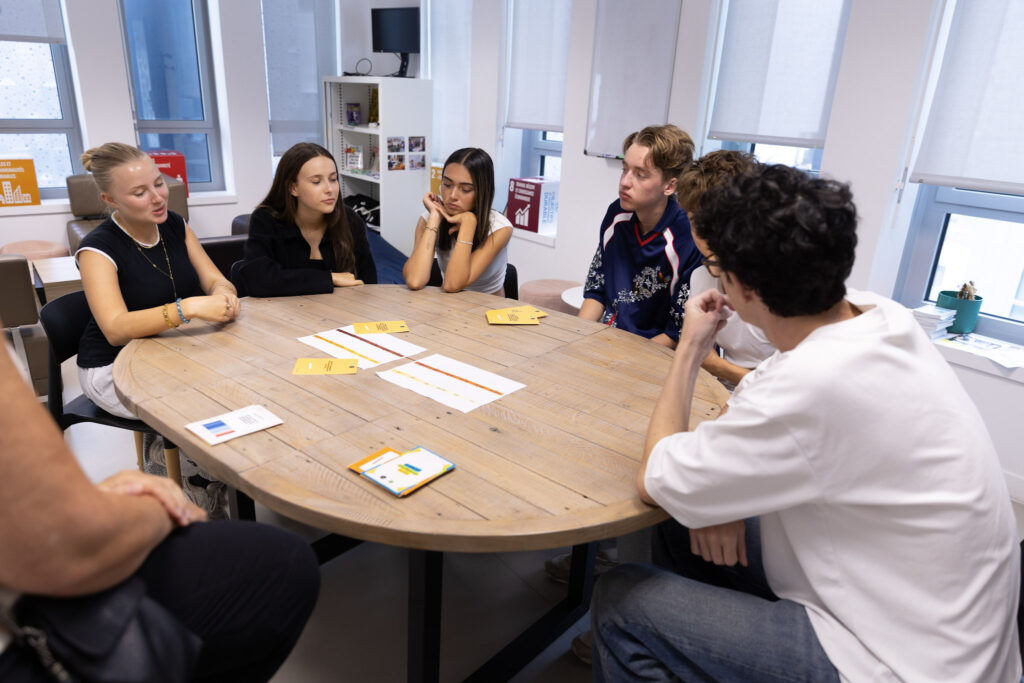
Equipping students to approach AI with clarity
To ensure the activity is facilitated effectively, the IÉSEG team leading this initiative (Sandrine DELCOURT, Flore BENVENUTI, Claire WEKSTEEN, and Emilie BUISINE from the CETI) completed a two-month online certification training program. This thorough preparation enables them to guide discussions thoughtfully, without steering students toward predetermined answers, while encouraging them to explore new perspectives.
Beyond technical proficiency, the primary goal of The AI Battle is to help students become informed, discerning citizens. Rather than portraying AI as something to fear, the game teaches them to approach it with a clear-eyed perspective: knowing when to use it, why to use it, and, above all, what limits to set. Understanding that AI can “hallucinate,” reproduce biases, or consume substantial amounts of energy is an essential step toward using these technologies responsibly and maintaining control over how they are applied.
“In a world where AI is becoming part of virtually everything we do, higher education has a crucial role to play in addressing these challenges. That is precisely why we are introducing initiatives of this kind at IÉSEG,” concludes Sandrine DELCOURT.