Back
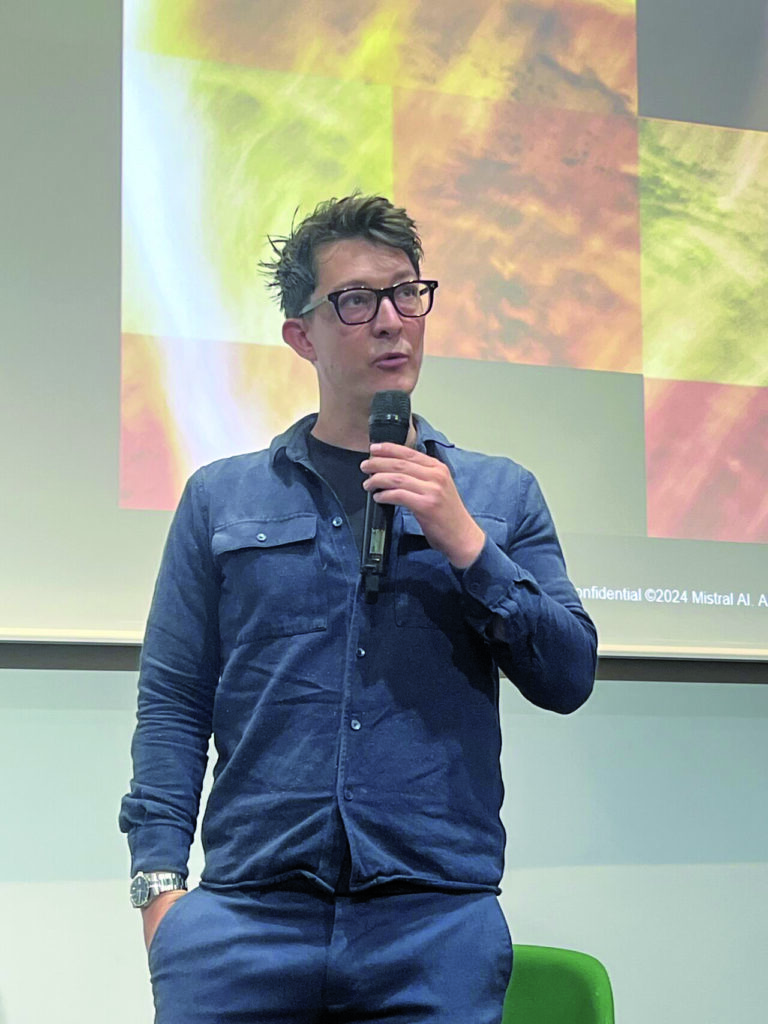
Between American and Chinese giants, does Europe still have a role to play in AI? Absolutely – at least according to Corentin HEINTZ (who graduated the Grande École Program in 2016). He is now Account Executive at Mistral, one of Europe’s leading players in large language models (LLMs). In his view, Europe – with France at the forefront – can rely on several key strengths: a dynamic start-up ecosystem, highly skilled talent, and a clear ambition to develop sovereign alternatives. From the practical applications of AI to ethical and environmental considerations, and its impact on the future job market, Corentin sheds light on a technological revolution already underway – one that is set to reshape tomorrow’s careers.
You have been working as an Account Executive at Mistral since September 2024. What can you tell us about the company?
Standards in this industry are extremely demanding. It is a highly specialized field that brings together only a limited number of experts and requires substantial investment, particularly due to the cost of Nvidia chips. What sets us apart is our ability to deploy our models and solutions with flexibility.
How does that flexibility translate in practice?
When it comes to using LLMs, organizations generally have two options: they can either rely on a model hosted by a provider or deploy an open-source model on their own infrastructure. Mistral offers both approaches. The second option is particularly attractive to critical sectors — such as finance, healthcare, or defense — which prefer to host models in their own data centers to minimize the risk of leakage.
What is an LLM?
A Large Language Model (LLM) is a type of artificial intelligence designed to understand and generate text in a natural way, similar to how humans communicate. Because they can write texts, translate them into different languages and engage in conversation, they represent a major step forward in the way machines interact with humans and process written language.
ChatGPT and Mistral, for example, are based on this type of model. LLMs are a specific branch of AI focused on language. They illustrate how AI can replicate — and even extend — certain human capabilities.
AI is often associated with strategic independence. Why is that, and what does it really mean?
Strategic independence is one of the key issues surrounding AI, particularly for companies. However, we need to remain realistic. Full sovereignty would imply relying exclusively on French LLMs, built with French-designed graphic cards, themselves manufactured from raw materials processed by French companies, all operating on French soil. In practice, that is simply impossible. A more pragmatic approach can be pursued at the European level: developing European models and solutions, hosted by European cloud providers – such as Scaleway or OVH in France – on American hardware (Nvidia).
Do you think Europe can stand out between American and Chinese giants?
Despite the hardware issue, largely dominated by Nvidia, Europe benefits from significant assets that could allow it to become the cradle of future AI champions: a highly qualified and more affordable workforce compared to the United States, and a market that actively seeks local solutions. France alone is home to many key players — Hugging Face (the leading open-source AI platform), Poolside, Dust, H, Photoroom… European companies have also produced globally recognized success stories, such as Black Forest Labs, Lovable and DeepL — and this is only the beginning.
What are your clients’ expectations when they come to you? How do you support them in adopting ai-based solutions?
We work with a broad range of clients. Some are at the very beginning of their AI transformation and are looking for guidance on what to prioritize and how best to implement it. This is often the case for higher education institutions, which need ready-to-use solutions to provide access to AI for an inexperienced audience. Others are more established players from the business world. These advanced users aim to improve the quality of outputs, reduce response times and optimize costs. Among them are scale-ups such as Qonto, Doctolib and Mirakl, which have dedicated teams working on the development of new features based on existing models. We are also frequently asked to integrate AI into more traditional processes to drive digital transformation on a broader scale.
Can you give a concrete example?
We worked with an industrial company on analyzing data from its production lines. By reducing analysis time thanks to AI, technicians are now able to make faster and more informed decisions. As a result, material waste has decreased and overall production output has increased. In the high-tech sector, the partnership between Mistral and ASML is another good example of how AI can improve efficiency on production lines.
Do clients value CSR in the solutions you offer?
Increasingly so. There is a growing awareness of these issues. Mistral contributes by publishing research – in collaboration with Carbone 4 – on the environmental impact of training and operating its models. It is the first study on this topic initiated by an LLM provider. We go even further by developing more energy-efficient processors that consume less electricity than those used by some of our American and Chinese counterparts.
Corentin HEINTZ’s career path
Corentin graduated in 2016 and began his career in Amazon Web Services’ (AWS) Graduate Program in Madrid. In 2017, he became Territory Manager in Luxembourg, and later Senior Account Manager in Amsterdam in 2019. In these roles, he supported companies in their digital transformation through his employer’s cloud services.
In late 2023, he witnessed his clients’ first uses of generative AI. Fascinated by the potential and accessibility of this tech-nology, he joined Mistral in September 2024 as an Account Executive in charge
of “Digital Natives”.
He oversees the entire sales cycle: qualifying leads, launching outbound campaigns, identifying priority use cases and the most suitable models and solutions within Mistral’s portfolio, negotiating contracts, managing digital transformation projects, and hosting demonstration sessions to help beginners adopt AI tools.
Do you – like some users – worry about the ethical aspects of AI? if so, how do you address those concerns?
Mistral provides – and will continue to provide – tools that are accessible to the public, who may use them responsibly or not. The accuracy of the information delivered – particularly through the chat interface – is therefore a key priority for us. To strengthen reliability, we have established an exclusive partnership with AFP (the French Press Agency). In addition, European regulation on AI (the AI Act) aims to regulate its use in sensitive areas such as recruitment, to prevent bias.
You mentioned Higher Education institutions. How do you convince them of the potential of your solutions?
For staff members, these tools can provide assistance by saving time, helping structure ideas, summarizing content or automating low value-added tasks. For lecturers and researchers, they can serve as pedagogical and research support – while fully respecting academic integrity and confidentiality protocols. As for students, AI can help them study more effectively by offering continuous support and enabling new learning formats: multiple-choice quizzes, slide decks, games, and more. They are not yet making full use of its potential and, in my view, it is the School’s responsibility to stay one step ahead on this issue.
Do you think they are ready?
Yes – and I am pleased to see that some schools, such as ESSEC, emlyon and, of course, IÉSEG, have established partnerships with Mistral or other AI players to implement their solutions. These initiatives train students in areas such as collaborative methods, prompt engineering and RAG libraries, which are already part of companies’ daily operations. Mastering these tools early on gives students a real head start, as they are becoming essential skills – much like Word and Excel were not so long ago.
How do you see AI in the future?
In the years ahead, AI will no longer be a choice but a necessity. I am convinced that it will have a massive impact on most jobs over the next decade. We are shifting from an AI primarily focused on writing and coding to voice-based applications (in sales or customer support), which will create new job opportunities. In the short term, robotics will also be strongly influenced by advances in AI models, particularly in autonomous decision-making. For companies, the future lies in achieving strategic independence through strong, flexible and ethical models that are also energy-efficient.
This article was written by Luna Créations for #IÉS, the IÉSEG Network magazine.