3 Terms + Capstone Project
Master in Cybersecurity Management Program
Protect your organization by becoming a leader in the exciting world of cybersecurity.
-

-

English
-

Lille
-

€26,800 (Fast Track) / €29,800 (Regular Track)
-

September
-

120 ECTS
Accreditations

PROGRAM
The Master in Cybersecurity Management provides a strategic perspective on cybersecurity, preparing students for success in a digital landscape characterized by evolving security challenges.
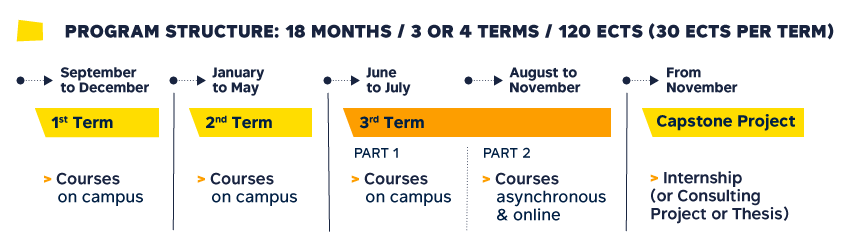
The program is offered on a full-time basis and consists of two (fast track) or three (regular track) academic semesters followed by an internship or master thesis semester. The second part of the third semester will be delivered in an asynchronous mode so students can start their capstone project in early September of the second academic year.
Alongside the courses, the program offers various workshops and corporate events to further develop students’ personal and professional skills. These cover a range of topics, from conflict management in cross-cultural environments to intercultural communication.
Program structure
IÉSEG’s Master in Cybersecurity Management is designed for students who are eager to live a multicultural and international experience, and offers two different tracks based on participants’ academic background:
> Fast Track: Participants who have 4 years of higher education (4-year Bachelor, Master or “M1” validated by an official degree equivalent to at least 240 ECTS credits) may request exemption from the 3rd term.
> Regular Track: for all participants. Mandatory for participants who have 3 years of higher education (Bachelor in 3 years, Licence/”Bac+3″) validated by an official degree with the equivalent of 180 ECTS credits.
> IÉSEG reserves the right to admit candidates with a 4-year degree into the Regular Track depending on the quality of their application.
> Due to a bilateral agreement between India and France, Indian students are required to take the Regular Track, regardless of the length of the Bachelor’s degree obtained.
Course Content
The program offers an integrated exploration of cybersecurity through three core pillars: Technology, Cybersecurity, and Management. to equip students with both the analytical expertise and leadership capabilities required to navigate modern cyber challenges.
> Technology
This set of courses provides the foundational technical knowledge to understand the nature of the assets to be protected and the threat vectors exploited. These fundamental building blocks allow participants to either focus on the technical aspects of cybersecurity or to be able to engage meaningfully with technical personnel.
> Cybersecurity
These courses establish the core knowledge and the practical security problem-solving skills required to assess the security of an organization, recommend and implement appropriate solutions, monitor and secure hybrid environments, including cloud, mobile and IoT, operate with an awareness of applicable laws and policies, including principles of governance, risk and compliance, and identify, analyse and respond to security events and incidents.
> Management
This set of courses covers the knowledge, skills, and abilities needed to manage organizational resources including physical, technical, intellectual, and human resources. They address managerial and leadership skills as well as the legal, compliance, and governance issues related to managing organizational risk.
ECTS

This course covers common tasks in major distributions of Linux, including the Linux command line, basic maintenance, installing and configuring workstations. It also covers basic shell scripting and automation. The curriculum is aligned to the CompTIA Linux+ certification exam.
This course provides the key concepts and terminology of computer technology including operating systems and networks including cloud infrastructure, blockchain, and Internet of Things (IoT).
Infrastructure standards, protocols and models, basic network components, topologies, functions, and processes will be explored.
The curriculum is aligned to the CompTIA Network+ and Cloud+ certification exams.
This course introduces the skills of data management professionals in deploying, managing, and maintaining database systems.
It focuses on foundational skills needed for tasks like database design, data processing, installation, security, and business continuity.
Additionally, students will develop skills in data mining, analysis, visualization, and governance.
The curriculum is aligned to the CompTIA DataSys+ and Data+ certification exams.
The curriculum is aligned to the CompTIA DataSys+ and Data+ certification exam.
This course provides basic programming literacy by teaching students to design, write, debug, and run programs in the Python programming language as well as understand software development process including computer systems design and software testing.
The curriculum is aligned to the Python Institute PCEP certification exam.
This course introduces the principles and practices of effective data visualization for analytical insight and communication.
Students will learn to transform complex data into clear, compelling visual narratives using modern tools and techniques.
Topics include visual perception, chart design, storytelling with data, dashboard creation, and best practices for communicating to technical and non-technical audiences.
Emphasis is placed on critical thinking, design integrity, and hands-on experience with visualization tools.
The course will focus on the legal protection of technical tools exploited in the digital realm, such as software, platforms, and databases including DRMs and AI.
Additionally, the course will focus on the protection of data circulating on the web. Thus, the course will contain an analysis of legal frameworks concerning personal data protection as well as a study of the provisions protecting non personal data, databases, and elaborated data.
It will include an analysis of the GDPR, in a comparative fashion with US norms, and of Intellectual Property Rights, with a focus on copyright, neighboring rights, and trade secrets.
Finally, the course will address the liability regimes that apply to host and content providers and contractual provisions that may be used in different frameworks.
Coming soon.
The Career Program aims to help IÉSEG students build and implement their professional objective in line with their aspirations, skills and the socio-economic reality of the market.
The objective is to facilitate their integration into the labor market, in an environment that allows them to develop personally and professionally.
All students benefit from a credited program tailored to their track or major, taught by a dedicated team of experienced professionals. The Career Program includes collective credit courses, digital resources, and on-demand coaching provided by the Career team for those who need additional support.
A cycle of thematic events fosters connections with companies and helps students build their professional networks. Our pedagogical approach blends various teaching methods, including digital modules, interactive and blended learning, coaching, peer-to-peer, learning by doing, live scenarios, debriefing, and reflection, in line with IÉSEG’s teaching and learning strategy.
Credited Language courses for all levels are included in the program.
French is the mandatory choice for any non-French speaking student. For native French speaking students, other languages are offered (Chinese, Spanish, German – list subject to change).
This course is intended to provide a general introduction to cybersecurity key concepts and terminology.
It includes explaining the types of threat that cybersecurity must address, the controls that can be implemented and means of mitigating cyber risk.
The need for security management in an organization is explained, and its main elements are introduced – including the key role played by risk management.
The importance of standardized approaches to security management is explained, as is the notion of compliance.
The curriculum is aligned to the CompTIA Security+ certification exam.
This course allows students to acquire the necessary skills of threats detection and response, compromised systems real-time analysis, and advanced methods of cyberattack detection.
Participants will learn to safely and ethically collect digital evidence, recover data, and organize digital imaging to help law enforcement prosecute those responsible for cybercrimes.
The curriculum is aligned to the CompTIA CyCA+ certification exam.
This course provides participants with the opportunity to learn from practitioners who discuss current threats, trends and challenges in cybersecurity and provides insights from their professional experience.
Students will also be exposed to security issues unique to certain industries such as healthcare, banking and financial services, automotive, and law enforcement.
The course introduces students to the fundamental principles of risk assessment and risk management, as they relate to information systems and the organizational threat landscape.
Furthermore, students learn to assess and manage both quantitative and qualitative risks. They also learn to describe and apply the risk management life cycle.
In addition, students learn to create and apply risk management communication and implementation strategies. Students learn to apply, and customize, common standards, practices, methods, and tools to assess and manage information risks for given scenarios.
They learn how to avoid common risk-management issues, and how to assess the maturity level of risk management in an organization, so that it can be improved upon.
Moreover, students learn about enterprise security controls and how they fit within the context of regulatory goals. They also learn how risk management can aid to ensure cyber security compliance.
This course provides a comprehensive introduction to the principles, practices, and tools of project management.
Students will learn how to plan, execute, monitor, control, and close projects effectively and efficiently across a range of industries.
The course covers key areas including project scope, time, cost, quality, human resources, risk, procurement, and stakeholder management.
Students will develop skills in scheduling (e.g., Gantt charts, critical path analysis), budgeting, risk assessment, and team leadership.
Emphasis is placed on aligning project goals with organizational strategy, as well as the use of software tools such as Microsoft Project or equivalent platforms. The course follows frameworks such as PMI’s PMBOK® Guide and Agile methodologies.
The curriculum is aligned to the CompTIA Project+ certification exam.
This course introduces decision analysis under uncertainty. The course consists of two parts.
The first part focuses on normative decision analysis, showing how to make “rational” decisions under uncertainty. It presents the foundations of Bayesian inference and decision making from a didactical perspective. Students will learn the basic analytical toolbox to model real-world decision problems, which will enable them to carry out decision analyses and prepare them for further exploration.
The second part of the course focuses on behavioral decision analysis, presenting various ways in which economic agents deviate from rationality due to cognitive biases in human judgment and decision making. This part will treat a range of topics from behavioral economics and psychology.
At the end of the course, the students will be able to apply insights from decision analysis in their future personal and professional careers to:
> make better decisions for themselves,
> help others make better decisions,
> better understand and predict people’s decisions in the face of uncertainty.
Coming soon.
The Career Program aims to help IÉSEG students build and implement their professional objective in line with their aspirations, skills and the socio-economic reality of the market.
The objective is to facilitate their integration into the labor market, in an environment that allows them to develop personally and professionally.
All students benefit from a credited program tailored to their track or major, taught by a dedicated team of experienced professionals. The Career Program includes collective credit courses, digital resources, and on-demand coaching provided by the Career team for those who need additional support.
A cycle of thematic events fosters connections with companies and helps students build their professional networks. Our pedagogical approach blends various teaching methods, including digital modules, interactive and blended learning, coaching, peer-to-peer, learning by doing, live scenarios, debriefing, and reflection, in line with IÉSEG’s teaching and learning strategy.
Credited Language courses for all levels are included in the program.
French is the mandatory choice for any non-French speaking student. For native French speaking students, other languages are offered (Chinese, Spanish, German – list subject to change).
This course provides hands-on pen testing training including vulnerability assessment, scanning and analysis, as well as planning, scoping, and managing weaknesses for the cloud, hybrid environments, web applications, Internet of Things (IoT) and traditional on-premises.
The curriculum is aligned to the CompTIA PenTest+ certification exam.
This course provides participants with the opportunity to learn from practitioners who discuss current threats, trends and challenges in cybersecurity and provides insights from their professional experience.
Students will also be exposed to security issues unique to certain industries such as healthcare, banking and financial services, automotive, and law enforcement.
The course introduces students to the fundamental principles and ethical application of IS governance practices.
Students learn about various IS governance frameworks. Furthermore, students learn to identify, describe, and apply applicable IS governance frameworks within an overall enterprise architecture framework.
They learn to assess the maturity, in terms of the performance and management, of these activities within the organization.
Students learn to apply IS governance in support of business strategies and objectives, whilst being aware of the limitations and common pitfalls when applying such governance frameworks.
This course provides participants with a profound understanding of entrepreneurship, new business development, and business plan writing.
Through lectures, testimonials, fieldwork, and group assignments, participants are confronted with the how, where, when, whom, and why of starting and developing new business activities.
As part of an international and multicultural team, participants are invited to work on an operational business plan aimed at either the creation of a new venture (NVC-track) or the acceleration of new business for an already established SME (NBD-track).
This course’s ambitions thus go beyond providing theoretical insights. Hands-on experience is gained through out-of-class field work covering all steps of the entrepreneurial decision-making process (e.g., idea generation, feasibility analysis, industry study, market analysis, marketing plan, production plan, product development, and financial statements).
In doing so, participants accumulate entrepreneurial knowledge and behaviors that support innovative solutions and new value development.
This course equips students with analytical tools and a strategic perspective to understand how geopolitical dynamics impact global business environments.
Through an interdisciplinary approach, students explore the influence of political risk, international relations, and global power shifts on trade, investment, supply chains, and corporate strategy.
Emphasis is placed on real-world cases and interactive discussions to help students assess geopolitical risk and adapt business decisions accordingly.
By the end of the course, participants will be able to integrate geopolitical thinking into strategic planning, enabling responsible and resilient decision-making in complex international contexts. Participants will also be able to integrate geopolitical thinking into strategic planning, enabling responsible and resilient decision-making in complex international contexts.
Particular attention is given to the social impact of geopolitical shifts, encouraging students to consider how business decisions can promote inclusive growth, ethical practices, and long-term societal resilience.
This is a modular, asynchronous course designed to provide participants with a comprehensive and integrated understanding of AI and its transformative impact on business strategy.
Bridging technical knowledge and strategic insight, the course guides learners through a rich curriculum that explores how AI drives innovation, enhances operational efficiency, and creates sustainable competitive advantages.
The learning journey culminates in real-world case studies that demonstrate how leading organizations have successfully integrated AI into their strategies, operations, and innovation processes. These examples provide actionable insights and help bridge theory with practical application.
Crucially, the course also engages with the broader societal and environmental impacts of AI, positioning ethical, ecological, and workforce considerations as central to strategic decision-making.
By the end of the course, participants will not only understand how AI works, but also how to deploy it responsibly and strategically for long-term business success in complex, dynamic environments.
Creativity is one of the critical components of an organization’s ability to survive and thrive in today’s competitive and dynamic markets.
This course will provide participants with a rich understanding of how creativity can be facilitated and managed in a work setting. They will acquire knowledge regarding various theoretical conceptualizations (i.e., how do you define creativity), antecedents (i.e., what makes you and others more creative) and outcomes (i.e., what is the impact) of creativity as well as knowledge on design thinking techniques and tools to lead teams in the creative journey.
How do creative ideas happen? How can we foster our creativity and the creativity of those around us? What are the paths of creative development of individuals who are successful in their creative endeavours? What are the implications for fostering and managing creativity in the workplace? What are the obstacles to creativity? What is the nature of creativity in teams and organizations? These are some of the questions we will address.
During the course, a variety of teaching and learning techniques (including design thinking) will be used to enable participants to think critically and imaginatively about various perspectives of creativity.
To realize the goal of a shared learning experience between participants and the instructor, the course is aimed at integrating real challenges and practical experiences of creativity, projects, presentations, experiential exercises, and critical reflection on the various course materials.
This advanced course provides a comprehensive exploration of how organizations can effectively manage, measure, and align performance at individual, team, and organizational levels.
The course begins by clarifying the concept of performance management – what it is, what it is not, and what characterizes effective strategic performance practices. Students will examine the challenges of defining and measuring performance accurately, and how to align performance indicators with broader strategic goals such as employee engagement, retention, and organizational growth.
Throughout the course, students will engage with a range of human resource management tools applicable at various stages of the performance management cycle. Legal, ethical, and reporting considerations—as well as software solutions—will also be addressed to provide a holistic understanding of modern performance systems.
A key focus of the course is the social dimension of performance management. Students will explore how to design systems that are valid, reliable, and fair for all employees, with a strong emphasis on eliminating bias and supporting diversity, inclusion, and social justice.
The course encourages critical assessment of whether performance systems genuinely enable all individuals, regardless of background, to demonstrate their full potential. This includes addressing how organizational culture, leadership behaviors, and system design can unintentionally disadvantage certain groups—and how such challenges can be effectively mitigated in practice.
Credited Language courses for all levels are included in the program.
French is the mandatory choice for any non-French speaking student. For native French speaking students, other languages are offered (Chinese, Spanish, German – list subject to change).
4-to 6-month internship or work experience anywhere in the world. Alternatively, students can opt for a consulting project or a thesis.
Please note that courses are subject to change; please check with the local contact if you have any questions.

Zoom on… Security Practitioners Colloquium
Cybersecurity is a vast and fast-paced field. To ensure that participants are exposed to the bleeding-edge issues facing practitioners, the program incorporates a Security Practitioners Colloquium.During each session, we invite a cybersecurity practitioner to address a specific topic, including industry-specific challenges, emerging risks, and technological innovations that are shaping the industry. These sessions allow participants to connect the knowledge learned in class with the reality of the cybersecurity landscape. It is also a great opportunity for them to interact with professionals in the field and get their invaluable insights.Additionally, students attend the InCyber Forum (formerly FIC), where they can participate in workshops, meet vendors, and network with potential employers.

Workshops and Corporate Events
Alongside the courses, the program includes various workshops and corporate events to further develop your personal and professional skills. These cover a range of topics, such as conflict management in cross-cultural environments and intercultural communication.
Our Career Program helps participants to establish their professional career plan by working on their skills, personal strengths, and using networking tools to be prepared to meet recruiters’ expectations internationally.
 Partnerships
Courses will include training material created by CISCO, a global leader in networking, through our partnership with the CISCO Networking Academy and Splunk, the leading Security Information and Event Management (SIEM) provider, through the Splunk Academic Alliance.
IÉSEG students in the Master in Cybersecurity Management will also have the opportunity to demonstrate their competence by earning two industry-recognized certifications through our partnership with CompTIA, the leading vendor-neutral IT certifying body.
All participants will take the CompTIA Security+ exam to demonstrate their cybersecurity knowledge. Each participant may take a second exam based on their preferred area of focus:
> Cybersecurity Analysis: CompTIA CySA+
> Cyber Analytics: CompTIA Data+ or DataSys+
> Cybersecurity Infrastructure: CompTIA Network+ or Linux+
Certifications have great value in the job market and are prerequisite for some positions. IÉSEG students will gain a competitive edge by earning these industry-recognized professional certifications.

Local contact
Find here your dedicated contact in your region.

