3 Terms + Capstone Project
Master in Finance Program
Your path to financial leadership and innovation.
-

-

English
-

Paris
-

€22,800 (Fast Track) / €25,800 (Regular Track)
-

September
-

120 ECTS
Accreditations




Program
The Master in Finance is developed to enhance the participants’ understanding of financial mechanisms.
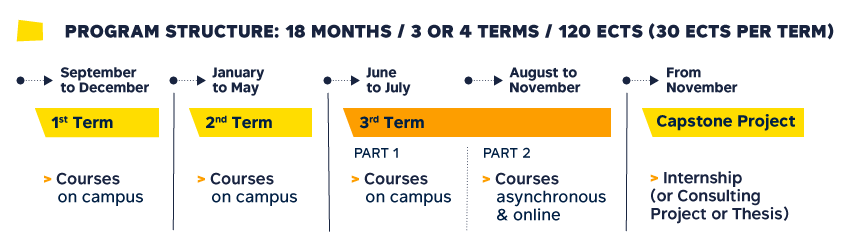
The program is offered on a full-time basis and consists of two (fast track) or three (regular track) academic semesters followed by an internship or master thesis semester. The second part of the third semester is delivered in an asynchronous mode so students can start their capstone project in early September of the second academic year.
The program is built on two specialization tracks: Financial Analysis (Track 1) and Banking, Capital Markets & Financial Technology (Track 2). The program’s curriculum is based on core courses and specialization track courses that rely on block course modules. Upon the completion of core courses, students choose their career path through uniquely designed specialization tracks. Students of this program benefit from essential certifications; Bloomberg certification, CFA and CISI.
The program provides students with a wide spectrum of training to prepare the future financial leaders in financial analysis, financial technology, banking, risk management and capital markets. The program offers courses to help them gain a better understanding of advanced topics in finance, including machine learning, financial modelling, risk analytics and artificial intelligence for finance.
Throughout the program, our students are well equipped and ready for the industry through the coursework on the ethics of finance, sustainability, financial regulation and compliance.
Program structure
IÉSEG’s Master in Finance is designed for students who are eager to live a multicultural and international experience, and offers two different tracks based on participants’ academic background:
> Fast Track: Participants who have 4 years of higher education (4-year Bachelor, Master or “M1” validated by an official degree equivalent to at least 240 ECTS credits) may request exemption from the 3rd term.
> Regular Track: for all participants. Mandatory for participants who have 3 years of higher education (Bachelor in 3 years, Licence/”Bac+3″) validated by an official degree equivalent to 180 ECTS credits.
> IÉSEG reserves the right to admit candidates with a 4-year degree into the regular track depending on the quality of their application.
> Due to a bilateral agreement between India and France, Indian students are required to take the regular track, regardless of the length of the Bachelor’s degree obtained.
Course Content
The program is offered on a full-time basis and consists of 3 consecutive terms of courses followed by a professional experience.
ECTS

This course provides a comprehensive introduction to the mathematical techniques and quantitative methods essential for financial analysis and modeling.
Students will explore topics which form the backbone of financial mathematics used in business practices.
The course further covers key concepts such as time value of money, risk and return, and the mathematics of financial instruments.
Through practical applications and problem-solving sessions, students will develop the skills necessary to apply these quantitative techniques to real-world financial problems, preparing them for technical coursework in the program and specializations.
The Financial Econometrics course delves into the statistical and econometric techniques used to analyze financial markets, financial data, and model relationships.
Students will learn to apply econometric methods, focusing on time series analysis, regression models volatility, and hypothesis testing.
Topics for applications include volatility measurement, empirical asset pricing, risk measurement, and forecasting.
Emphasis is placed on practical cases using software tools for empirical analysis, allowing students to interpret and critically evaluate financial research and data.
By the end of the course, students will be equipped with the quantitative skills necessary to conduct rigorous financial analysis and contribute to decision-making in various finance roles.
Introduction to Programming course equips students with foundational skills in algorithmic thinking and structured problem-solving.
Through a step-by-step exploration of core programming concepts—such as variables, conditionals, loops, and algorithm design—students learn to approach problems methodically and develop precise, logical solutions.
The course emphasizes clarity, correctness, and conceptual understanding before diving into code automation, using tools like AlgoBox to visualize program behavior.
Topics include the structure of algorithms, decision-making logic, repetition, and basic algorithmic strategies such as search and approximation.
Students will also engage in analyzing and refining solutions, gaining early insights into efficiency and modularity.
Designed to support learners from diverse academic backgrounds, this course lays a solid groundwork for programming.
The objective of this course is to put forward an in-depth exploration of the principles and practices involved in the management of investment portfolios.
Students will study asset allocation, diversification strategies, and risk-return optimization, gaining insights into the construction and management of both individual and institutional portfolios.
The course covers modern portfolio theory, the efficient market hypothesis, and the capital asset pricing model (CAPM), alongside alternative investment strategies and performance evaluation techniques.
Through case studies and hands-on projects, Master’s in Finance students will develop the analytical and decision-making skills required to design and manage portfolios that meet specific investment goals and risk tolerances in a dynamic financial environment.
Real-world case studies and the latest research in behavioral finance and market dynamics are integrated to enhance practical understanding and decision-making skills.
This course serves as a foundational exploration into the intricate workings of global financial markets.
Students will delve into the fundamental principles governing financial markets, including the roles of various participants such as investors, institutions, and regulatory bodies.
Topics covered in this core course include the essential structure and fundamental functions of equity, fixed income, and derivative markets, along with an examination of key financial instruments traded within these markets.
Emphasis is placed on understanding market efficiency, risk management techniques, and the impact of economic factors on market dynamics.
By the end of the course, students will have developed a comprehensive understanding of how financial markets facilitate capital allocation and drive economic growth in both domestic and international contexts.
The Debt Markets & Fixed Income Securities course aims to provide an overview of debt markets and the intricate world of fixed income securities.
Students will learn about various types of debt instruments, including government and corporate bonds, mortgage-backed securities, and other structured products.
Valuation methods, risk characteristics, and pricing dynamics specific to fixed income securities will be covered during the course.
Through case studies and real-world examples, students will gain practical insights into how interest rates, credit risk, and market liquidity impact bond pricing and trading strategies.
The course also covers regulatory frameworks governing debt markets and explores the role of central banks and monetary policy in influencing fixed income markets.
By the end of the course, students will be equipped with the analytical tools and knowledge necessary to navigate and make informed decisions within the complex realm of debt markets and fixed income securities.
The International Finance core course explores the complexities of financial systems on a global scale, focusing on the interplay between international markets, currencies, and institutions.
Key topics of the course include foreign exchange markets, exchange rate determination, international trade finance, and capital flows.
Emphasis is placed on understanding the implications of globalization on financial decision-making for multinational corporations, governments, and investors.
The course also covers international financial institutions like the IMF and World Bank, as well as regulatory frameworks that govern cross-border transactions.
Through case studies and simulations, students will gain practical insights into managing currency risk, evaluating investment opportunities in foreign markets, and navigating geopolitical influences on international finance.
This course examines thoroughly derivative securities, which are financial instruments whose value is derived from an underlying asset or benchmark.
Students will examine the main types of derivatives, including futures, forwards, options, and swaps, and delve into their uses for hedging, speculation, and arbitrage.
The course covers essential topics such as pricing models, risk management strategies, and the mechanics of trading derivatives in both exchange-traded and over-the-counter markets.
Emphasis is placed on understanding the role derivatives play in managing various types of financial risk, including interest rate risk, currency risk, and commodity price risk.
Through case studies and practical exercises, students will develop the analytical skills necessary to evaluate derivative contracts and construct effective hedging strategies for corporate and institutional clients.
Coming soon.
The Career Program aims to help IÉSEG students build and implement their professional objective in line with their aspirations, skills and the socio-economic reality of the market.
The objective is to facilitate their integration into the labor market, in an environment that allows them to develop personally and professionally
All students benefit from a credited program tailored to their track or major, taught by a dedicated team of experienced professionals.
The Career Program includes collective credit courses, digital resources, and on-demand coaching provided by the Career team for those who need additional support.
A cycle of thematic events fosters connections with companies and helps students build their professional networks.
Our pedagogical approach blends various teaching methods, including digital modules, interactive and blended learning, coaching, peer-to-peer, learning by doing, live scenarios, debriefing, and reflection, in line with IÉSEG’s teaching and learning strategy.
Credited Language courses for all levels are included in the program.
French is the mandatory choice for any non-French speaking student.
For native French speaking students, other languages are offered (Chinese, Spanish, German – list subject to change).
This course provides a comprehensive introduction to the principles and practices of financial accounting, focusing on the preparation, analysis, and interpretation of financial statements.
Students will learn the fundamental concepts of accounting, including the accounting cycle, accruals, revenue recognition, and expense matching.
Topics covered include the preparation of balance sheets, income statements, and cash flow statements in accordance with generally accepted accounting principles (GAAP).
Emphasis is placed on understanding the role of financial accounting in providing information to external stakeholders such as investors, creditors, and regulatory authorities.
Through innovative pedagogic approaches, students will develop the skills necessary to analyze financial statements, assess financial performance, and make informed decisions based on accounting information.
The course will help students have a solid foundation in financial accounting principles and be prepared to apply them in various business contexts.
Financial Statement Analysis course in this specialization focuses on the systematic evaluation of financial statements to assess the financial health and performance of companies.
Students will learn analytical techniques to interpret financial statements including the balance sheet, income statement, and cash flow statement.
Various important measures utilized in this domain, such as financial ratios, liquidity ratios, profitability ratios, and leverage ratios, and their application in evaluating profitability, operational efficiency, and financial risk will be explored.
The course covers methods for comparing companies within the same industry and across different sectors, as well as techniques for forecasting future financial performance based on historical data.
Through case studies and real-world examples, students will develop skills in identifying financial strengths and weaknesses, conducting financial due diligence, and making informed investment and lending decisions.
By the end of the course, students will be equipped with the analytical tools and knowledge necessary to critically examine financial statements and communicate their findings effectively to stakeholders.
Data Visualization with Power BI course in this specialization focuses on leveraging Power BI, a powerful business analytics tool by Microsoft, to create compelling and interactive data visualizations.
Students will learn how to connect to various data sources, transform and model data, and design visually appealing dashboards and reports.
The course covers techniques for creating calculated columns and measures using DAX (Data Analysis Expressions) to enhance data analysis capabilities within Power BI.
Through hands-on projects and practical exercises, students will gain proficiency in building insightful visualizations that facilitate data-driven decision-making across different business domains.
This course provides a comprehensive overview of the principles and practices of corporate finance, focusing on the financial decisions made by corporations to maximize shareholder value.
Students will explore key topics such as capital budgeting, capital structure decisions, dividend policy, and working capital management.
Emphasis is placed on understanding the theoretical frameworks and practical applications of financial concepts, including time value of money, cost of capital, and risk-return trade-offs.
The course covers techniques for evaluating investment opportunities, including net present value (NPV) analysis, internal rate of return (IRR), and sensitivity analysis.
Students will also examine the role of financial markets and institutions in corporate financing decisions, including debt and equity financing options.
Through case studies and real-world examples, students will develop analytical skills to assess financial performance, optimize capital allocation, and make strategic financial decisions in competitive business environments.
By the end of the course, students will have a solid foundation in corporate finance principles and be prepared to apply them in various managerial roles within corporations.
This course provides a comprehensive assessment of the methodologies and techniques used to determine the value of a firm.
Students will delve into both theoretical frameworks and practical applications of firm valuation, including discounted cash flow (DCF) analysis, comparable company analysis (CCA), and precedent transactions analysis.
Emphasis is placed on understanding the factors that influence a firm’s valuation, such as industry dynamics, market conditions, and macroeconomic factors.
The course covers advanced topics including the estimation of cost of capital, terminal value calculation, and adjustments for non-operating assets and liabilities.
Through case studies and valuation exercises, students will gain hands-on experience in applying valuation models to real-world scenarios and making valuation judgments.
Students will have developed the skills necessary to critically evaluate and estimate the value of companies across different sectors and markets.
The Mergers and Acquisitions course explores the strategic and financial aspects of mergers and acquisitions (M&A), looking into the processes involved in corporate restructuring and expansion through acquisitions and mergers.
Students will examine the motivations behind M&A activities, including achieving economies of scale, market expansion, synergies, and strategic realignment.
Emphasis is placed on understanding the various stages of the M&A process, from initial valuation and deal structuring to post-merger integration and performance evaluation.
The course covers different types of M&A transactions, such as mergers of equals, acquisitions of assets, and hostile takeovers, along with the regulatory and legal considerations that govern these transactions.
Students will gain practical insights into negotiating M&A deals, conducting due diligence, addressing challenges related to cultural integration and stakeholder management, and execute successful M&A transactions in complex and dynamic business environments.
This course introduces students to the application of Python programming language in financial analysis, modeling, and decision-making.
Students will learn how to use Python libraries such as NumPy, Pandas, Matplotlib, and SciPy to manipulate financial data, perform statistical analysis, and visualize results.
Emphasis is placed on understanding the integration of Python for financial analysis that is designed for this specialization.
By the end of the course, students will be equipped with the basic programming skills necessary to uncover financial data for managerial decisions.
Focusing on the role of economic factors in corporate decisions, the course presents applied frameworks pertaining to economic principles and their application in corporate decision-making processes.
Students will examine microeconomic concepts such as supply and demand, market structures, pricing strategies, and cost analysis, with a focus on how these concepts influence managerial decisions within firms.
Emphasis is placed on understanding macroeconomic factors such as inflation, interest rates, and economic indicators, and their impact on corporate strategy and operational planning.
The course covers topics including decision-making under uncertainty, risk management, and the role of government policies in shaping business environments.
Through case studies and real-world examples, students will develop analytical skills to evaluate economic trends, forecast market conditions, and make informed strategic decisions that optimize profitability and sustainability.
By the end of the course, students will have a solid foundation in economic theory and its practical applications in corporate settings, preparing them to navigate economic challenges and opportunities in global markets.
This course explores the principles and practices of credit risk management within financial institutions and corporate environments.
Students will examine the process of assessing, monitoring, and mitigating credit risk across various types of lending and investment activities.
Emphasis is placed on understanding credit risk measurement techniques, including credit scoring models, credit ratings, and probability of default (PD) estimation.
The course covers methodologies for evaluating borrower creditworthiness, assessing collateral, and structuring credit agreements to minimize risk exposure.
Topics also include credit risk modeling, stress testing, and regulatory frameworks governing credit risk management practices.
Through case studies and practical exercises, students will develop skills in identifying, quantifying, and managing credit risks effectively.
By the end of the course, students will be equipped with the knowledge and tools necessary to make informed credit decisions, optimize risk-return trade-offs, and contribute to the overall financial stability of organizations.
Coming soon.
The Career Program aims to help IÉSEG students build and implement their professional objective in line with their aspirations, skills and the socio-economic reality of the market.
The objective is to facilitate their integration into the labor market, in an environment that allows them to develop personally and professionally
All students benefit from a credited program tailored to their track or major, taught by a dedicated team of experienced professionals. The Career Program includes collective credit courses, digital resources, and on-demand coaching provided by the Career team for those who need additional support. A cycle of thematic events fosters connections with companies and helps students build their professional networks. Our pedagogical approach blends various teaching methods, including digital modules, interactive and blended learning, coaching, peer-to-peer, learning by doing, live scenarios, debriefing, and reflection, in line with IÉSEG’s teaching and learning strategy.
Credited Language courses for all levels are included in the program.
French is the mandatory choice for any non-French speaking student.
For native French speaking students, other languages are offered (Chinese, Spanish, German – list subject to change).
This course provides an in-depth exploration of the role and functions of investment banks in the global financial system.
Students will examine the various divisions within investment banks, capital markets, and sales and trading.
The course puts emphasis on presenting the process of raising capital through debt and equity markets, structuring financial transactions, and providing advisory services to clients.
The course covers key topics such as valuation techniques, financial modeling designed for banking practices, due diligence, and regulatory considerations in investment banking operations.
Through case studies and real-world examples, students will gain practical insights into the complexities of deal-making, negotiating transactions, and managing client relationships in the investment banking industry.
By the end of the course, students will be equipped with the knowledge and skills necessary to pursue careers in investment banking within the financial industry.
The Banking and Financial Intermediaries course in this specialization focuses on the role and operations of banks and other financial intermediaries in the banking system.
Students will explore the functions of commercial banks, investment banks, and other financial institutions in facilitating the flow of funds between savers and borrowers.
Emphasis is placed on understanding the regulatory framework governing banking activities, including capital requirements, liquidity management, and risk management practices.
The course covers key topics such as deposit-taking, lending, asset-liability management, and the creation of financial products and services tailored to customer needs.
The course will prepare students through insights into the challenges and opportunities facing banking institutions in a dynamic economic environment.
This course immerses students in a dynamic, hands-on simulation designed to replicate real-world banking scenarios.
Participants will take on roles within a virtual banking institution, making strategic decisions across various departments such as retail banking, corporate banking, risk management, and financial operations.
The course will integrate knowledge of banking principles, regulations, and customer needs to optimize profitability and manage risks effectively.
Students will experience the complexities of banking operations, including customer acquisition and retention, loan origination and credit assessment, investment portfolio management, and compliance with regulatory requirements.
The course provides opportunities for students to apply theoretical concepts to practical situations, develop critical thinking skills, and enhance teamwork and decision-making abilities.
Students following this specialization will have gained valuable insights into strategic banking management and be prepared to navigate challenges in the competitive banking industry.
The Advanced Derivative Securities course delves into advanced concepts and strategies related to derivative securities, focusing on their application in capital markets, money markets, and risk management.
Students will explore sophisticated derivative products beyond basic options and futures, including exotic options, structured products, and complex derivatives used in institutional settings.
The course will enhance students’ learning experience through analytical methods towards pricing models, trading strategies, and hedging techniques associated with advanced derivatives.
The course covers topics such as volatility trading, interest rate derivatives, credit derivatives, and the role of derivatives in managing portfolio risk and enhancing returns.
Through case studies and practical exercises, students will thus develop proficiency in valuing complex derivative securities, assessing their business impact on financial institutions and capital markets.
The course will prepare students to acquire the rigorous analytical skills and practical knowledge necessary to navigate and leverage advanced derivative instruments effectively in the context of financial services and capital markets.
This course provides the tools and methods for market risk analysis and measurement that are critical for financial institutions, traders and market participants.
Students will explore the various types of market risk, including interest rate risk, foreign exchange risk, equity risk, and commodity risk, and examine the techniques used to quantify these risks.
Emphasis of the course is placed primarily on employing market risk models such as Value at Risk (VaR), stress testing, scenario analysis, and their application in risk management frameworks.
The course covers regulatory requirements for market risk management, including Basel Committee guidelines and regulatory capital calculations.
Topics also include risk-adjusted performance measurement, risk appetite frameworks, and the integration of market risk with other forms of risk management.
Through case studies and simulations, students will gain practical insights into identifying, measuring, and mitigating market risk exposures in financial institutions.
The objective of this course is to explore advanced strategies and techniques in asset management, focusing on factor investing and its application in portfolio management.
Students will delve into the principles of factor investing, which involves targeting specific risk factors such as value, momentum, size, quality, and low volatility to enhance portfolio returns or manage risk.
Factor models, factor attribution analysis, and the construction of factor-based portfolios will be introduced.
The course covers advanced topics such as multi-factor models, factor timing strategies, and the integration of factor investing with traditional asset allocation approaches.
Students following this specialization and taking this course will also examine empirical evidence and case studies pertaining to the efficacy of factor investing across different market environments.
The course will prepare students to gain concise formation proficiency in implementing factor-based investment strategies, evaluating factor performance, and managing factor exposures in investment portfolios.
The Capital Markets and Investment Simulation course combines conceptual knowledge with practical experience through a dynamic simulation focused on capital markets and trading strategies. Students will participate in a virtual (gamified) environment where they will assume roles as investors, traders, and portfolio managers, making decisions across various asset classes including equities, fixed income, derivatives, and alternative investments. Emphasis is placed on understanding market dynamics, analyzing economic indicators, and executing trading strategies to optimize risk-adjusted portfolio performance. The simulation covers key aspects of capital markets, including trading mechanisms, buy-sell decisions, pricing analysis and the impact of real-time market behavior on investment decisions. Hands-on experience and real-time market simulations will help students bring their technical skills to a different level for portfolio construction, risk analytics, and decision-making under uncertainty.
This course builds upon foundational Python programming skills to explore advanced topics and techniques relevant to applications in banking, capital markets, and financial technology.
Students will delve into advanced Python libraries and frameworks such as NumPy, Pandas, SciPy, and scikit-learn, focusing on their application in financial data analysis.
The course puts emphasis on developing scalable and efficient solutions for financial problems, and covers topics for data management, analytics and the integration of Python with financial APIs and databases.
Students will gain proficiency in writing clean, maintainable code and applying advanced programming techniques to solve real-world financial challenges.
The methods and frameworks covered in the course will allow students to be equipped with the skills necessary to leverage Python effectively in the finance industry, enhancing their ability to innovate and optimize processes in banking, capital markets, and financial technology sectors.
The Machine Learning course in Banking, Capital Markets & Financial Technology specialization prepares students to learn and apply the essential machine learning techniques for solving complex finance problems.
Students will delve into supervised learning algorithms tailored to financial data analysis, measuring and prediction practices.
Course covers key concepts including regression-based financial machine learning, classification-based financial machine learning, feature engineering, model evaluation, model selection, regularization, overfitting, as well as bias-variance trade-off specific to financial datasets.
Through hands-on projects and using real-world financial data, students will gain practical experience in implementing machine learning algorithms to solve financial problems and carry out predictive analytics.
By the end of the course, students will be equipped with the skills to leverage machine learning effectively in finance, enabling them to extract insights, make informed decisions, and innovate within the banking, capital markets, and financial technology sectors.
The Mathematics for Capital Markets course equips students with the essential mathematical foundations needed to understand and analyze the quantitative dynamics of modern capital markets.
The course covers key topics such as probability and statistics, linear algebra, calculus, and optimization techniques, providing a unified toolkit for tackling complex financial problems.
These mathematical concepts form the backbone of advanced applications including machine learning in finance, derivative pricing, portfolio optimization, and continuous-time financial models.
Emphasis is placed on both theoretical understanding and practical relevance, preparing students to engage with the analytical challenges of today’s data-driven financial landscape.
The course is designed to offer the rigor needed for further study in quantitative finance within the Banking, Capital Markets & Financial Technology track.
The Connected Vision Tour – Hackathon immerses students in an experiential learning environment within the Master in Banking, Capital Markets, and Financial Technology specialization.
The course encourages collaborative problem-solving using cutting-edge technologies and let students work in teams to develop innovative solutions, gaining practical experience in rapid prototyping, agile development, and presenting their ideas to industry mentors.
The course culminates in presentations where teams showcase their solutions, fostering entrepreneurial skills and innovation in financial services.
Throughout the hackathon, students will have access to sessions with professionals from leading financial institutions and/or technology companies, offering guidance and feedback on their projects.
This close interaction with the industry helps bridge the gap between academic knowledge and practical application, ensuring that students are well-prepared for careers in the financial sector, as they demonstrate their ability to tackle complex financial challenges with creativity and technical competencies.
Coming soon.
The Career Program aims to help IÉSEG students build and implement their professional objective in line with their aspirations, skills and the socio-economic reality of the market.
The objective is to facilitate their integration into the labor market, in an environment that allows them to develop personally and professionally
All students benefit from a credited program tailored to their track or major, taught by a dedicated team of experienced professionals. The Career Program includes collective credit courses, digital resources, and on-demand coaching provided by the Career team for those who need additional support. A cycle of thematic events fosters connections with companies and helps students build their professional networks. Our pedagogical approach blends various teaching methods, including digital modules, interactive and blended learning, coaching, peer-to-peer, learning by doing, live scenarios, debriefing, and reflection, in line with IÉSEG’s teaching and learning strategy.
Credited Language courses for all levels are included in the program.
French is the mandatory choice for any non-French speaking student.
For native French speaking students, other languages are offered (Chinese, Spanish, German – list subject to change).
This advanced specialization course on Private Wealth Management provides a wide spectrum of examination of strategies and practices involved in managing the financial affairs of high-net-worth individuals and families.
Students will explore the principles of private wealth management, including goal setting, asset allocation, risk management, and estate planning.
Emphasis is placed on understanding the unique needs and preferences of wealthy clients, and tailoring investment strategies and financial plans to achieve their personal and financial objectives.
The course covers various investment vehicles available to private clients, including equities, fixed income securities, alternative investments, and structured products.
Topics also include tax planning, philanthropy, family governance, and intergenerational wealth transfer strategies.
Through case studies and simulations, students will develop practical skills in client relationship management, financial analysis, and portfolio construction for affluent individuals.
By the end of the course, students will be prepared to provide personalized wealth management services, address complex financial challenges, and uphold fiduciary responsibilities in serving private clients effectively.
This course builds upon foundational valuation principles to delve into advanced methodologies and techniques used in determining the value of a firm.
Students will explore sophisticated valuation models, including discounted cash flow (DCF) analysis, adjusted present value (APV) analysis, and option pricing models applied to real options in strategic decision-making.
Emphasis is placed on understanding complex factors influencing firm valuation, such as industry dynamics, market conditions, and macroeconomic variables.
The course covers advanced topics including the valuation of intangible assets, synergy analysis in mergers and acquisitions, and the impact of financial distress and restructuring on firm value.
Students will develop proficiency in applying advanced valuation techniques to diverse business scenarios, including cross-border transactions and emerging market contexts.
The course will prepare students to have the analytical skills and strategic insight necessary to critically evaluate and estimate the value of companies in complex and dynamic environments.
The Alternative Investments course explores the diverse landscape of alternative investments beyond traditional stocks and bonds, focusing on strategies that offer unique risk-return profiles and diversification benefits.
Students will examine various types of alternative investments, including private equity, hedge funds, real estate, commodities, and structured products.
Emphasis is placed on understanding the characteristics, valuation methods, and performance metrics specific to each alternative asset class.
The course covers the role of alternative investments in portfolio construction, risk management techniques, and regulatory considerations.
Topics also include due diligence processes, liquidity constraints, and the impact of market cycles on alternative investments.
The Energy & Commodity Finance course offers an in-depth exploration of the financial principles, instruments, and market dynamics specific to the global energy and commodity sectors.
The course blends foundational finance concepts with real-world applications, focusing on areas such as pricing, risk management, derivatives, and investment strategies in energy and raw materials markets.
Students will examine the role of commodities in global finance, the impact of geopolitical and environmental factors, and the structure of physical vs. financial trading.
Emphasis is placed on analytical thinking, data interpretation, and understanding market behavior under uncertainty.
Designed to accommodate various academic backgrounds, the course is structured to evolve with emerging trends and technologies, providing a flexible platform for both theoretical insight and practical skill development.
This course provides participants with a profound understanding of entrepreneurship, new business development, and business plan writing.
Through lectures, testimonials, fieldwork, and group assignments, participants are confronted with the how, where, when, whom, and why of starting and developing new business activities.
As part of an international and multicultural team, participants are invited to work on an operational business plan aimed at either the creation of a new venture (NVC-track) or the acceleration of new business for an already established SME (NBD-track).
This course’s ambitions thus go beyond providing theoretical insights.
Hands-on experience is gained through out-of-class field work covering all steps of the entrepreneurial decision-making process (e.g., idea generation, feasibility analysis, industry study, market analysis, marketing plan, production plan, product development, and financial statements).
In doing so, participants accumulate entrepreneurial knowledge and behaviors that support innovative solutions and new value development.
This course equips students with analytical tools and a strategic perspective to understand how geopolitical dynamics impact global business environments.
Through an interdisciplinary approach, students explore the influence of political risk, international relations, and global power shifts on trade, investment, supply chains, and corporate strategy.
Emphasis is placed on real-world cases and interactive discussions to help students assess geopolitical risk and adapt business decisions accordingly.
By the end of the course, participants will be able to integrate geopolitical thinking into strategic planning, enabling responsible and resilient decision-making in complex international contexts.
Participants will also be able to integrate geopolitical thinking into strategic planning, enabling responsible and resilient decision-making in complex international contexts.
Particular attention is given to the social impact of geopolitical shifts, encouraging students to consider how business decisions can promote inclusive growth, ethical practices, and long-term societal resilience.
This is a modular, asynchronous course designed to provide participants with a comprehensive and integrated understanding of AI and its transformative impact on business strategy.
Bridging technical knowledge and strategic insight, the course guides learners through a rich curriculum that explores how AI drives innovation, enhances operational efficiency, and creates sustainable competitive advantages.
The learning journey culminates in real-world case studies that demonstrate how leading organizations have successfully integrated AI into their strategies, operations, and innovation processes.
These examples provide actionable insights and help bridge theory with practical application.
Crucially, the course also engages with the broader societal and environmental impacts of AI, positioning ethical, ecological, and workforce considerations as central to strategic decision-making.
By the end of the course, participants will not only understand how AI works, but also how to deploy it responsibly and strategically for long-term business success in complex, dynamic environments.
Creativity is one of the critical components of an organization’s ability to survive and thrive in today’s competitive and dynamic markets.
This course will provide participants with a rich understanding of how creativity can be facilitated and managed in a work setting.
They will acquire knowledge regarding various theoretical conceptualizations (i.e., how do you define creativity), antecedents (i.e., what makes you and others more creative) and outcomes (i.e., what is the impact) of creativity as well as knowledge on design thinking techniques and tools to lead teams in the creative journey.
How do creative ideas happen? How can we foster our creativity and the creativity of those around us? What are the paths of creative development of individuals who are successful in their creative endeavours? What are the implications for fostering and managing creativity in the workplace? What are the obstacles to creativity? What is the nature of creativity in teams and organizations? These are some of the questions we will address.
During the course, a variety of teaching and learning techniques (including design thinking) will be used to enable participants to think critically and imaginatively about various perspectives of creativity.
To realize the goal of a shared learning experience between participants and the instructor, the course is aimed at integrating real challenges and practical experiences of creativity, projects, presentations, experiential exercises, and critical reflection on the various course materials.
This advanced course provides a comprehensive exploration of how organizations can effectively manage, measure, and align performance at individual, team, and organizational levels.
The course begins by clarifying the concept of performance management – what it is, what it is not, and what characterizes effective strategic performance practices.
Students will examine the challenges of defining and measuring performance accurately, and how to align performance indicators with broader strategic goals such as employee engagement, retention, and organizational growth.
Throughout the course, students will engage with a range of human resource management tools applicable at various stages of the performance management cycle.
Legal, ethical, and reporting considerations—as well as software solutions—will also be addressed to provide a holistic understanding of modern performance systems.
A key focus of the course is the social dimension of performance management.
Students will explore how to design systems that are valid, reliable, and fair for all employees, with a strong emphasis on eliminating bias and supporting diversity, inclusion, and social justice.
The course encourages critical assessment of whether performance systems genuinely enable all individuals, regardless of background, to demonstrate their full potential.
This includes addressing how organizational culture, leadership behaviors, and system design can unintentionally disadvantage certain groups—and how such challenges can be effectively mitigated in practice.
Credited Language courses for all levels are included in the program.
French is the mandatory choice for any non-French speaking student.
For native French speaking students, other languages are offered (Chinese, Spanish, German – list subject to change).
This course explores the transformative potential of blockchain technology in the context of modern business practices.
Providing the fundamentals of blockchain, including its decentralized nature, cryptographic principles, and consensus mechanisms, the course curriculum is designed to help students learn blockchain applications beyond cryptocurrencies, such as supply chain management, digital identity verification, smart contracts, and decentralized finance (DeFi).
The course covers important topics in this domain, such as blockchain architecture, scalability challenges, regulatory considerations and the integration of blockchain with existing business processes.
Students will have the chance to dive into hands-on experience in implementing blockchain solutions and assessing the strategic implications of blockchain adoption for business innovation and efficiency.
By the end of the course, students will be equipped with the knowledge and skills to leverage blockchain technology effectively in various industries, primarily in banking, capital markets and financial technology.
This advanced specialization course unravels the applications of artificial intelligence (AI) techniques and technologies in the realm of capital markets.
Students taking this course will delve into advanced AI algorithms and models used for processing financial data, predicting market trends, and optimizing investment strategies.
Emphasis is placed on understanding how AI can enhance decision-making processes in trading, portfolio management, risk assessment, and regulatory compliance within financial institutions.
The course further covers topics such as natural language processing (NLP), sentiment analytics, as applied to real financial data.
Students will gain practical experience in developing AI-driven solutions tailored to capital market challenges and be equipped with the skills to leverage AI effectively to extract practically relevant insights.
This course delves into advanced machine learning techniques and their applications within the financial industry.
Students will explore sophisticated algorithms and models tailored for financial data analysis, prediction, and decision-making.
Going beyond supervised machine learning, this course places more emphasis on learning unsupervised machine learning which can be used to enhance trading strategies, portfolio management, risk assessment, and financial forecasting.
Key topics include ensemble methods, deep learning architectures for time series data, reinforcement learning for trading strategies, news analytics and large language models applied to financial cases and business problems.
By the end of the course, students will be equipped with the skills to leverage a full spectrum of machine learning methods effectively in financial prediction and seeking solutions to managerial challenges.
The Data Analytics for Risk & Asset Allocation course focuses on the application of data analytics techniques in the context of risk management and asset allocation within financial institutions.
Students will explore the principles and methodologies of data-driven decision-making, with an emphasis on quantitative analysis, statistical measurement, and predictive analytics.
The course covers key topics such as data analytics for sustainable finance, climate change, risk measurement and mitigation strategies, and the use of big data in data-driven financial forecasting.
Students will learn how data analytics can enhance risk assessment processes, improve asset allocation strategies, and optimize portfolio performance.
This course’s objective is to equip students with essential tools and strategies for effective trading in global financial markets.
Unlike the traditional courses on investment practices, this course will allow participants to obtain formation and insights into the operational aspects of trading desks, including the use of advanced trading platforms, market analysis tools, and order execution strategies.
Through practical simulations and case studies, students will develop proficiency in using key trading tools such as algorithmic trading systems, charting software, and market data analysis tools.
The course covers trading across various asset classes, including equities, derivatives, and currencies, and explores the impact of regulatory environments on trading practices.
By the end of the course, students will be prepared to navigate global markets effectively and make informed trading decisions using advanced tools and strategies available on modern trading desks.
This course provides participants with a profound understanding of entrepreneurship, new business development, and business plan writing.
Through lectures, testimonials, fieldwork, and group assignments, participants are confronted with the how, where, when, whom, and why of starting and developing new business activities.
As part of an international and multicultural team, participants are invited to work on an operational business plan aimed at either the creation of a new venture (NVC-track) or the acceleration of new business for an already established SME (NBD-track).
This course’s ambitions thus go beyond providing theoretical insights.
Hands-on experience is gained through out-of-class field work covering all steps of the entrepreneurial decision-making process (e.g., idea generation, feasibility analysis, industry study, market analysis, marketing plan, production plan, product development, and financial statements).
In doing so, participants accumulate entrepreneurial knowledge and behaviors that support innovative solutions and new value development.
This course equips students with analytical tools and a strategic perspective to understand how geopolitical dynamics impact global business environments.
Through an interdisciplinary approach, students explore the influence of political risk, international relations, and global power shifts on trade, investment, supply chains, and corporate strategy.
Emphasis is placed on real-world cases and interactive discussions to help students assess geopolitical risk and adapt business decisions accordingly.
By the end of the course, participants will be able to integrate geopolitical thinking into strategic planning, enabling responsible and resilient decision-making in complex international contexts.
Participants will also be able to integrate geopolitical thinking into strategic planning, enabling responsible and resilient decision-making in complex international contexts.
Particular attention is given to the social impact of geopolitical shifts, encouraging students to consider how business decisions can promote inclusive growth, ethical practices, and long-term societal resilience.
This is a modular, asynchronous course designed to provide participants with a comprehensive and integrated understanding of AI and its transformative impact on business strategy.
Bridging technical knowledge and strategic insight, the course guides learners through a rich curriculum that explores how AI drives innovation, enhances operational efficiency, and creates sustainable competitive advantages.
The learning journey culminates in real-world case studies that demonstrate how leading organizations have successfully integrated AI into their strategies, operations, and innovation processes.
These examples provide actionable insights and help bridge theory with practical application.
Crucially, the course also engages with the broader societal and environmental impacts of AI, positioning ethical, ecological, and workforce considerations as central to strategic decision-making.
By the end of the course, participants will not only understand how AI works, but also how to deploy it responsibly and strategically for long-term business success in complex, dynamic environments.
Creativity is one of the critical components of an organization’s ability to survive and thrive in today’s competitive and dynamic markets.
This course will provide participants with a rich understanding of how creativity can be facilitated and managed in a work setting.
They will acquire knowledge regarding various theoretical conceptualizations (i.e., how do you define creativity), antecedents (i.e., what makes you and others more creative) and outcomes (i.e., what is the impact) of creativity as well as knowledge on design thinking techniques and tools to lead teams in the creative journey.
How do creative ideas happen? How can we foster our creativity and the creativity of those around us? What are the paths of creative development of individuals who are successful in their creative endeavours? What are the implications for fostering and managing creativity in the workplace? What are the obstacles to creativity? What is the nature of creativity in teams and organizations? These are some of the questions we will address.
During the course, a variety of teaching and learning techniques (including design thinking) will be used to enable participants to think critically and imaginatively about various perspectives of creativity.
To realize the goal of a shared learning experience between participants and the instructor, the course is aimed at integrating real challenges and practical experiences of creativity, projects, presentations, experiential exercises, and critical reflection on the various course materials.
This advanced course provides a comprehensive exploration of how organizations can effectively manage, measure, and align performance at individual, team, and organizational levels.
The course begins by clarifying the concept of performance management – what it is, what it is not, and what characterizes effective strategic performance practices.
Students will examine the challenges of defining and measuring performance accurately, and how to align performance indicators with broader strategic goals such as employee engagement, retention, and organizational growth.
Throughout the course, students will engage with a range of human resource management tools applicable at various stages of the performance management cycle.
Legal, ethical, and reporting considerations—as well as software solutions—will also be addressed to provide a holistic understanding of modern performance systems.
A key focus of the course is the social dimension of performance management.
Students will explore how to design systems that are valid, reliable, and fair for all employees, with a strong emphasis on eliminating bias and supporting diversity, inclusion, and social justice.
The course encourages critical assessment of whether performance systems genuinely enable all individuals, regardless of background, to demonstrate their full potential.
This includes addressing how organizational culture, leadership behaviors, and system design can unintentionally disadvantage certain groups—and how such challenges can be effectively mitigated in practice.
Credited Language courses for all levels are included in the program.
French is the mandatory choice for any non-French speaking student.
For native French speaking students, other languages are offered (Chinese, Spanish, German – list subject to change).
4-to 6-month internship or work experience anywhere in the world. Alternatively, students can opt for a consulting project or a thesis.
Please note that courses are subject to change; please check with the local contact if you have any questions.

Zoom on… the two specializations
Our program offers two distinct specializations, allowing students to tailor their studies to career path:
> Specialization in Financial Analysis
The financial analysis track focuses on the corporate finance pillar, equipping students with advanced technical skills necessary for in-depth financial analysis, corporate valuation, and strategic financial decision-making. The track prepares students for roles such as financial analysts, corporate finance advisors and financial managers.
> Specialization in Banking, Capital Markets, and Financial Technology
Our banking, capital markets and financial technology specialization targets the dynamic sectors of banking and capital markets, integrating the latest advancements in financial technology. The specialization prepares students for careers and leadership positions in investment banking, trading, financial technology and capital markets. The graduates acquiring this unique specialization aim at working at leading international financial institutions and organizations.
Students choose the specialization best suited to their career goals at the end of the first semester of joint courses.

Workshops and Corporate Events
Alongside the courses, the program includes various workshops and corporate events to further develop your personal and professional skills. These cover a range of topics, such as conflict management in cross-cultural environments and intercultural communication.
Our Career Program helps participants to establish their professional career plan by working on their skills, personal strengths, and using networking tools to be prepared to meet recruiters’ expectations internationally.
INTERNSHIP
During their internship, students are able to combine theories of management with hands-on experience and apply the cross-cultural skills they have developed at IÉSEG.
Business Development Intern, Depositary Analyst, Financial Analyst, Financial Risk Manager, Operation Analyst, Research Content Manager, Risk Management Specialist, S&M Controlling Intern, Strategy & Corporate or Talent Acquisition Partner for example: the internship opportunities offered by the program at the end of the curriculum are multiple.
Some companies which hire our interns: Audi, DataYes, advinda Investor Cloud, Industrial Securities Co.Ltd., Huajing Securities, Bank of America Merrill Lynch, Quilvest Asset Management S.A., Langham Hall, Alter Domus, Thomson Reuters, Amundi Asset Management, etc.
The internship can be undertaken in France or abroad. Most students have done their internships in Asia, in Europe, in Africa or in South America for example.
Corporate involvement in the program
Companies are an integral part of the academic life of the Specialised Master. Throughout the program, students have the opportunity to meet and network with companies of all sizes on topics related to the master, such as conferences, in-class interventions, challenges or tailor-made recruitment. Partnerships may vary from one to another and new opportunities may be proposed according to needs and availability.
Examples of previous events organized for the Master in Finance*:
> Company visits in Belgium and Luxembourg: SRB – BDO – SWIFT – UBS – PWC – DELOITTE
> Company presentations and job opportunities: presentation of opportunities and access the Traineeship campaign program – EUROPEAN CENTRAL BANK
> Company presentation and tips to apply – SOCIETE GENERALE
> Conference “Green finance: what’s next” – BANQUE DU LUXMBOURG – RSM – ROTHSCHILD
> In class Intervention: Management for sustainability – Sustainable Finance – ALLIANZ TRADE
> Conference “Women in Finance” – CAP GEMINI – EY – MAZARS
*Non-exhaustive list
CFA Institute University Recognition Program

Our program prepares students for the Chartered Financial Analyst® (CFA®) level 1 examination that is the first step (out of 3) that leads to the attainment of the CFA® credential awarded to investment and finance professionals by the world-renowned CFA® Institute.
The CFA® charter offers a permanent advantage in the job market and distinguishes CFA charter holders throughout their career paths. Furthermore, our program gives students the possibility to participate in the global CFA® Research Challenge that constitutes an intensive training in the domain of financial analysis.
The Master in Finance curriculum covers at least 70 percent of the CFA Program ‘Candidate Body of Knowledge’ (CBOK) and places a particular emphasis on the CFA Institute Code of Ethics and Standards of Practice. Consequently, it positions students well to obtain the Chartered Financial Analyst® (CFA) designation, which has become the most respected and recognized investment credential in the world.
Through participation in the CFA Institute University Affiliation Program, IÉSEG is able to grant up to 19 student scholarships per year. Students who choose to participate in the CFA level 1 exam are offered 16 hours of coaching sessions.
They are also provided with a unique opportunity to represent IÉSEG in the CFA Institute Research Challenge, an international student contest aimed at promoting best practices in equity research.

Local contact
Find here your dedicated contact in your region

