3 Terms + Capstone Project
Master in Business Analysis & Consulting Program
Build and develop your analysis skills for consulting.
-

-

English
-

Paris
-

€18,800 (Fast Track) / €21,800 (Regular Track)
-

September
-

120 ECTS
Accreditations



Curriculum
The Master in Business Analysis & Consulting is developed to equip participants with all the analytical and managerial skills required to fully understand how sustainable performance can be achieved and how change can be implemented in a company operating in a global context.
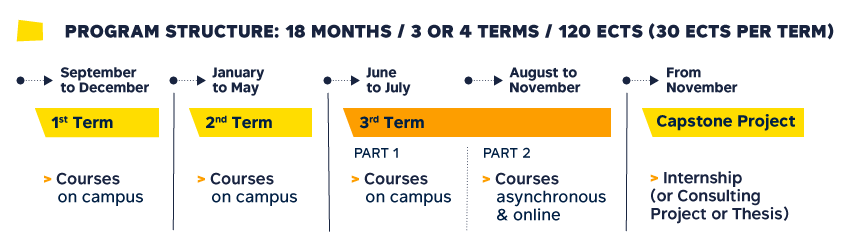
The program is offered on a full-time basis and consists of two (fast track) or three (regular track) academic semesters followed by an internship or a master thesis semester. The second part of the third semester will be delivered in an asynchronous mode so students can start their capstone project in early September of the second academic year.
The curriculum is developed around core and elective courses and the structure is based on a mix of theory and practice.
During the courses, you will apply relevant and up to date concepts, models and theories, through case studies. Consequently, each course will help you to further develop your analytical and communication skills as well as your teamwork capabilities.
Program structure
IÉSEG’s Master in Business Analysis & Consulting is designed for students who are eager to live a multicultural and international experience, and offers two different tracks based on participants’ academic background:
> Fast Track: Participants who have 4 years of higher education (4-year Bachelor, Master or “M1” validated by an official degree equivalent to at least 240 ECTS credits) may request exemption from the 3rd term.
> Regular Track: for all participants. Mandatory for participants who have 3 years of higher education (Bachelor in 3 years, Licence/”Bac+3″) validated by an official degree with the equivalent of 180 ECTS credits.
> IÉSEG reserves the right to admit candidates with a 4-year degree into the Regular Track depending on the quality of their application.
> Due to a bilateral agreement between India and France, Indian students are required to take the Regular Track, regardless of the length of the Bachelor’s degree obtained.
Course content
The program is offered on a full-time basis and consists of 3 consecutive terms of courses followed by a professional experience.
ECTS

At the end of the course, the student should be able to:
> understand the general principles of strategy formulation understand the general principles of strategy formulation and international business strategy;
> develop the competences to apply the basic frameworks to make effectual business decisions – understand how to integrate in an intercultural environment;
> leverage international business information to formulate solutions in complex and unfamiliar situations;
> develop sustainable strategic solutions for companies;
> apply in-depth knowledge to leverage opportunities in the professional field – define failure and success factors of international business strategy;
> understand the role of different stakeholders for strategic challenges;
> understand different internationalization strategies – understand how the environment affects strategy.
At the end of the course, the student should be able to:
> Communicate effectively in English to explain a business model.
> Breakdown complex organizational problems using the appropriate methodology; specifically, use BPMN and UML to model business processes.
> Use metaphors to describe creative approaches to business problems.
> Convey powerful messages using contemporary presentation techniques; specifically, present, explain, and discuss a business model.
> Determine problem areas in a process and design solutions for those problem areas.
> Employ state-of-the-art management techniques (BPMN and UML).
> Demonstrate expertise on key concepts, techniques and trends in their professional field; specifically modelling, troubleshooting, improving, and redesigning business processes.
> Be a reference point for expertise-related questions and ambiguities about business processes.
This course introduces students to consulting tools and methods, presenting consulting project activities and real-life examples using business cases.
At the end of the course, the student should be able to:
> Assess the values of the organization in which they work.
> Breakdown complex organizational problems using the appropriate methodology.
> Propose creative solutions within an organization.
> Organize change management processes.
> Employ state-of-the-art management techniques.
> Be a reference point for expertise-related questions and ambiguities.
> Understand the nature and rigour of management consulting.
> Manage the client relationships and effectively address problem situations with diverse executive types.
> Demonstrate effective knowledge of the code of ethics in management consulting.
At the end of the course, the student should be able to:
> Breakdown a complex problem into smaller parts, especially when the problem is nontrivial.
> Formulate appropriate solution to solve each part of the complex problem: being able to select the relevant tools, select the right data, avoid mis-presentation…
> Cross check data, identify outliers and solve missing data problems.
> Collect relevant data using surveys and sampling methods.
> Understand the importance of wording and variable description.
> Propose creative solutions given the understanding of the data.
> Master basic tools: correlation, box plot, distributions, payoff tables…
> Select the relevant method: Baye’s analysis, confidence intervals, parametric and non-parametric tests… and be able to check assumptions (normality…).
> Master expect knowledge tools and understand the new trends in analysis.
> Analyze numerical and especially categorical data.
> Demonstrate expertise in advanced tools and methods: SPC/SQC, Acceptance Sampling, Capability, Control charts, Decision Rules.
> Link statistics with management methods and quality tools such as the six-Sigma.
> Formulate, model and solve optimization problems.
> Be open to new developments in their field of competence and be a reference point for those developments.
> Master a professional software.
At the end of the course, the student should be able to:
> acquire an advanced knowledge of how to interpret and analyze financial statement;
> demonstrate an expertise on key concepts, techniques and trends in their professional field;
> understand the application of this expertise for making effectual decisions as accountants, equity analysts, lenders, investment bankers, boards of directors, or external consultants charged with monitoring or advising on corporate performance and the behavior of management;
> deliver an effective oral presentation of important course concepts applied to a real life company;
> successfully collaborate within an intercultural team on any professional project involving technical skills acquired during the course;
> communicate effectively in English any aspect of the expertise thus acquired.
At the end of the course, the student should be able to:
> Identify the purpose of a business (its missions) and discuss the issues to be considered when setting the financial aims and objectives of a business.
> Explain the role of management accounting within a business and describe the key qualities that management accounting information should possess.
> Explain the changes that have occurred over time in both the role of the management accountant and the type of information provided by management accounting systems
> Define and distinguish between relevant costs, outlay costs and opportunity costs.
> Identify and quantify the costs that are relevant to a particular decision.
> Use relevant costs to make decisions.
> Set out relevant cost analysis in a logical form so that the conclusion may be communicated to managers.
> Deduce the full (absorption) cost of a cost unit
> Discuss the problems and the usefulness of full (absorption) cost information to managers.
> Describe the nature of the modern product costing and pricing environment.
> Discuss the principles and practicalities of activity-based costing.
> Explain how new developments such as total life cycle costing and target costing can be used to manage product costs.
> Explain the theoretical underpinning of pricing decisions and discuss the issues involved in reaching a pricing decision in real-world situations.
> Discuss the nature and role of strategic management accounting.
> Explain how management accounting information can help a business gain a better understanding of its competitors and customers.
Coming soon.
The Career Program aims to help IÉSEG students build and implement their professional objective in line with their aspirations, skills and the socio-economic reality of the market.
The objective is to facilitate their integration into the labor market, in an environment that allows them to develop personally and professionally
All students benefit from a credited program tailored to their track or major, taught by a dedicated team of experienced professionals. The Career Program includes collective credit courses, digital resources, and on-demand coaching provided by the Career team for those who need additional support.
A cycle of thematic events fosters connections with companies and helps students build their professional networks. Our pedagogical approach blends various teaching methods, including digital modules, interactive and blended learning, coaching, peer-to-peer, learning by doing, live scenarios, debriefing, and reflection, in line with IÉSEG’s teaching and learning strategy.
Credited Language courses for all levels are included in the program.
French is the mandatory choice for any non-French speaking student. For native French speaking students, other languages are offered (Chinese, Spanish, German – list subject to change).
This course is based on a business management simulation game that integrates the functional areas of production, marketing, logistics, finance and strategy. It increases participants’ awareness of operating a company from a general management perspective.
At the end of the course, the student should be able to understand how to design and implement a strategy for different kinds of markets; interpret and forecast market situations and financial results and translate them into goal-oriented decisions; analyse problems, find solutions and take decisions in a context characterized by changes; recognize the interactions among the various companies and external stakeholders in a complex and interrelated environment.
The course objective is to cover the supply chain strategy and concepts and to give students a solid understanding of the analytical tools necessary to solve the supply chain problems.
As a result, the goals and objectives are as follows:
> Describe how a company achieves strategic fit between its supply chain strategy and its competitive strategy.
> Identify the major drivers of supply chain performance, understand how they are related.
> Understand the trade-offs between different SC networks.
> Apply the concepts to improve supply chain performance.
> Analyze a supply chain network, identify the problems and suggest improvement solutions focusing on the key drivers of the supply chain.
> Model a simple supply chain network as a Mixed integer programming problem and solve it.
> Use efficiently decision trees to compute the NPV of different supply chain network alternatives.
> Analyze global supply chain network design decisions in an uncertain environment.
> To present and demonstrate their understanding of the material, students will have to present their work effectively in English. Students will also have to demonstrate their capability in composing constructive feedback.
The objective of this course is to make students knowledgeable about issues and opportunities in change management, and to give them tools and methods to analyze the change situation, the possible obstacles, and how to manage them, in order to act as responsible change agents in their future company.
The first part of the course is focused on understanding where resistance to change might come from, and how to diagnose problems that organizations might face when implementing new technologies or other type of change interventions. The second part of the course focuses on solution and best practices in change interventions.
At the end of the course, the students should be able to:
> Understand drivers & motivations for change in organizations;
> Design a whole change management process, with its different phases, through change concepts, models and analytical tools to understand and;
> Address change management-related challenges companies face, such as resistance to change.
Coming soon.
At the end of the course, the student should be able to:
> Measure and explain producer performances.
> Define and measure efficiency and productivity.
> Apply microeconomic analysis to decision methods of businesses or other management units.
> Bridge economic theory and management in practice.
> Use quantitative techniques such as index numbers, productivity accounting, price recoveries.
> Apply benchmarking and performance analysis to real managerial data.
> Develop a research project within a multi-cultural student group.
> Present results orally to a committee composed of academic and professional members.
At the end of the course, the student should be able to:
> Communicate effectively in English: Be able to debate and present an informed argumentation about the pros and cons of various management control systems.
> Organize change management processes: Understand how management control systems impact decisions and practices, and how they participate in change processes, and put this understanding in practice.
> Appraise the performance of a team: Evaluate the performance of a business unit in its various aspects (variance analysis, financial indicators, multi-dimensional performance…)
> Make effectual organizational decisions: Know how to use management control systems in making efficient decisions.
Data Analysis with Python
This course introduces students to the basics of programming with python and its application in data analytics.
Cybersecurity
This course provides an overview of information security and cybersecurity risk assessment and management as well as privacy. Students will learn to identify information assets, threats, and vulnerabilities; conduct risk assessment; and prioritize risk management efforts. Additionally, students will learn to research relevant laws, standards, and best practices.
Data Visualization
At the end of the course the student should be able to :
> Collect, synthesize, and analyze data to support decision making.
> Understand and apply foundational knowledge in data visualization.
> Critique other visualizations to identify where design and analysis improvements could be made to better their form and function.
> Use data visualization software to create informative, efficient, and effective data visualizations within a storyboard format with a continuous narrative.
> Synthesize conclusions from data supported through an effective data narrative and visualizations.
> Create a storyboard/narrative that efficiently and effectively “tells the story of their data and analysis” to a general audience to support decision making.
> Determine the conclusions and recommendations for action from their data analysis and efficiently and effectively convey these through their storyboard and visualizations.
> Orally convey (i.e., present) the analysis, conclusions, and recommendations to a professional audience.
Excel VBA
This course reviews some advanced Excel functionalities and basic VBA programming structures
SAP for Business Process Management
At the end of the course, the student should be able to:
> Breakdown complex organizational problems using the appropriate methodology.
> Construct expert knowledge from cutting-edge information.
> Demonstrate an expertise on key concepts, techniques and trends in their professional field.
> Apply their fundamental theoretical knowledge of an ERP system and particularly the SAP ERP software.
> Describe process components and their integration in the SAP ERP system.
> Learn about the structure of data in SAP software.
> Develop skills concerning the implementation of SAP ERP system.
> Demonstrate knowledge of SAP modules.
> Work within a HCM module of SAP ERP environment.
The Mindful Manager
“The Mindful Manager” is an introductory seminar conceived as a learning journey into mindfulness practice for business school students and future managers. It seeks to give you an introduction to mindfulness practice and theory and allow you to experience how it might be useful in your professional life.
Coming soon.
The Career Program aims to help IÉSEG students build and implement their professional objective in line with their aspirations, skills and the socio-economic reality of the market.
The objective is to facilitate their integration into the labor market, in an environment that allows them to develop personally and professionally
All students benefit from a credited program tailored to their track or major, taught by a dedicated team of experienced professionals. The Career Program includes collective credit courses, digital resources, and on-demand coaching provided by the Career team for those who need additional support.
A cycle of thematic events fosters connections with companies and helps students build their professional networks. Our pedagogical approach blends various teaching methods, including digital modules, interactive and blended learning, coaching, peer-to-peer, learning by doing, live scenarios, debriefing, and reflection, in line with IÉSEG’s teaching and learning strategy.
Credited Language courses for all levels are included in the program.
French is the mandatory choice for any non-French speaking student. For native French speaking students, other languages are offered (Chinese, Spanish, German – list subject to change).
This course will give a global view on human resources management with a chosen focus on how to build engaging organizations and foster engaged people and teams, rather than describing process-only policies. The course will use a combination of lecture, discussion, individual work and team workshops.
At the end of the course, students should be able to:
> Outline the interactions between human capital management and organizational performance in a multicultural environment;
> Understand the key differences between satisfaction, motivation and employee engagement;
> Demonstrate basic knowledge on what is driving team performance and behaviour, and what characterizes an engaging leader;
> Discuss how HR and CSR can monitor organizational engagement and improve the employee experience at work.
The goal of this course is to give students the tools to create/maintain fruitful international business relationships through negotiation processes aiming to reach mutually satisfying outcomes.
The content of the course will be centered on the following topics: distributive and integrative negotiation settings and strategies, the influence of culture in negotiation strategy and a glimpse into complexity in international negotiations. Overall, the objective is to provide key concepts and analysis grids, to be useful in various professional settings, in particular in intercultural settings.
This course will consist of a mix of theory delivered to the students and application exercises and realistic role plays. Class discussion will be based on the students’ performance in the exercises and the concepts will be illustrated by the group’s experience in negotiation. Active class discussion will enable appropriation of the concepts and to create links with the participants’ past experience.
In this course, students will be actively learning by dealing with data themselves, involving data manipulation, data cleaning, analyzing and visualization.
Considering the various background of students, contextually if some of them have previous experience with statistics or data analytics, this course is designed to be covering various projects for students to choose which is most in line with their background with individual instructions on project sessions.
This course is essential to all future careers involving with data. Specifically, the knowledge gained in this course will be beneficial to finance or management context.
The project will be based on real world data which allows students to develop relevant competences.
This course is designed to provide an overview of machine learning and artificial intelligence approaches and to demonstrate how those techniques are applied in decision-making.
Course contents:
> Overview of Machine Learning and Artificial Intelligence in day-to-day life.
> Fundamental Supervised Learning algorithms with case studies
> Fundamental Unsupervised Learning algorithms with case studies
> Some words on Artificial Neural Network and Deep Learning
> Best practice in Data Science
The course will conclude with some open discussions regarding the future of ML/AI in industry and society in general.
This course provides participants with a profound understanding of entrepreneurship, new business development, and business plan writing.
Through lectures, testimonials, fieldwork, and group assignments, participants are confronted with the how, where, when, whom, and why of starting and developing new business activities. As part of an international and multicultural team, participants are invited to work on an operational business plan aimed at either the creation of a new venture (NVC-track) or the acceleration of new business for an already established SME (NBD-track).
This course’s ambitions thus go beyond providing theoretical insights. Hands-on experience is gained through out-of-class field work covering all steps of the entrepreneurial decision-making process (e.g., idea generation, feasibility analysis, industry study, market analysis, marketing plan, production plan, product development, and financial statements).
In doing so, participants accumulate entrepreneurial knowledge and behaviors that support innovative solutions and new value development.
This course equips students with analytical tools and a strategic perspective to understand how geopolitical dynamics impact global business environments.
Through an interdisciplinary approach, students explore the influence of political risk, international relations, and global power shifts on trade, investment, supply chains, and corporate strategy. Emphasis is placed on real-world cases and interactive discussions to help students assess geopolitical risk and adapt business decisions accordingly.
By the end of the course, participants will be able to integrate geopolitical thinking into strategic planning, enabling responsible and resilient decision-making in complex international contexts. Participants will also be able to integrate geopolitical thinking into strategic planning, enabling responsible and resilient decision-making in complex international contexts.
Particular attention is given to the social impact of geopolitical shifts, encouraging students to consider how business decisions can promote inclusive growth, ethical practices, and long-term societal resilience.
This is a modular, asynchronous course designed to provide participants with a comprehensive and integrated understanding of AI and its transformative impact on business strategy.
Bridging technical knowledge and strategic insight, the course guides learners through a rich curriculum that explores how AI drives innovation, enhances operational efficiency, and creates sustainable competitive advantages.
The learning journey culminates in real-world case studies that demonstrate how leading organizations have successfully integrated AI into their strategies, operations, and innovation processes. These examples provide actionable insights and help bridge theory with practical application.
Crucially, the course also engages with the broader societal and environmental impacts of AI, positioning ethical, ecological, and workforce considerations as central to strategic decision-making. By the end of the course, participants will not only understand how AI works, but also how to deploy it responsibly and strategically for long-term business success in complex, dynamic environments.
Creativity is one of the critical components of an organization’s ability to survive and thrive in today’s competitive and dynamic markets. This course will provide participants with a rich understanding of how creativity can be facilitated and managed in a work setting.
They will acquire knowledge regarding various theoretical conceptualizations (i.e., how do you define creativity), antecedents (i.e., what makes you and others more creative) and outcomes (i.e., what is the impact) of creativity as well as knowledge on design thinking techniques and tools to lead teams in the creative journey.
How do creative ideas happen? How can we foster our creativity and the creativity of those around us? What are the paths of creative development of individuals who are successful in their creative endeavours? What are the implications for fostering and managing creativity in the workplace? What are the obstacles to creativity? What is the nature of creativity in teams and organizations? These are some of the questions we will address.
During the course, a variety of teaching and learning techniques (including design thinking) will be used to enable participants to think critically and imaginatively about various perspectives of creativity. To realize the goal of a shared learning experience between participants and the instructor, the course is aimed at integrating real challenges and practical experiences of creativity, projects, presentations, experiential exercises, and critical reflection on the various course materials.
This advanced course provides a comprehensive exploration of how organizations can effectively manage, measure, and align performance at individual, team, and organizational levels.
The course begins by clarifying the concept of performance management – what it is, what it is not, and what characterizes effective strategic performance practices. Students will examine the challenges of defining and measuring performance accurately, and how to align performance indicators with broader strategic goals such as employee engagement, retention, and organizational growth.
Throughout the course, students will engage with a range of human resource management tools applicable at various stages of the performance management cycle. Legal, ethical, and reporting considerations—as well as software solutions—will also be addressed to provide a holistic understanding of modern performance systems.
A key focus of the course is the social dimension of performance management. Students will explore how to design systems that are valid, reliable, and fair for all employees, with a strong emphasis on eliminating bias and supporting diversity, inclusion, and social justice.
The course encourages critical assessment of whether performance systems genuinely enable all individuals, regardless of background, to demonstrate their full potential. This includes addressing how organizational culture, leadership behaviors, and system design can unintentionally disadvantage certain groups—and how such challenges can be effectively mitigated in practice.
Credited Language courses for all levels are included in the program.
French is the mandatory choice for any non-French speaking student. For native French speaking students, other languages are offered (Chinese, Spanish, German – list subject to change).
4-to 6-month internship or work experience anywhere in the world. Alternatively, students can opt for a consulting project or a thesis.
Please note that courses are subject to change; please check with the local contact if you have any questions.

Zoom on… A conscious mix of theory and practice
The Master in Business Analysis & Consulting is based on a very conscious mix of theory and practice, which is necessary to prepare students for a career as a consultant or business analyst.
Professors teaching in the program have experience in consulting or related areas. Professionals are also invited as guest speakers in some courses to demonstrate how theory can be put into practice. Additionally, the program offers a series of “Meet the Experts” seminars.
These seminars can be course-specific, such as the seminar organized for the “Business Process Modelling” course, or they can be program-specific. In the latter case, professionals assign students a real-life scenario that requires them to put into practice what they have learned in the different areas of the program. This offers a unique opportunity for students to benchmark their own recommendations against the options implemented by the professionals.

Workshops and Corporate Events
Alongside the courses, the program includes various workshops and corporate events to further develop your personal and professional skills. These cover a range of topics, such as conflict management in cross-cultural environments and intercultural communicationz.
Our Career Program helps participants to establish their professional career plan by working on their skills, personal strengths, and using networking tools to be prepared to meet recruiters’ expectations internationally.
INTERNSHIP
During their internship, students are able to combine theories of management with hands-on experience and apply the cross-cultural skills they have developed at IÉSEG.
Business Analyst, Project Manager, Consultant, Marketing Consultant, Technology Analyst or Pricing Analyst for example: the internship opportunities offered by the program at the end of the curriculum are multiple.
Some companies which hire our interns: Atos, Deloitte, KPMG, CWT, Sephora, Vinci, etc.
The internship can be undertaken in France or abroad. Most students have done their internships in France, in Europe or in Asia for example.
Corporate involvement in the program
Companies are an integral part of the academic life of this Specialized Master. Throughout the program, students have the opportunity to meet and network with companies of all sizes on topics related to the master, such as conferences, in-class interventions, challenges or tailor-made recruitment. Partnerships may vary and new opportunities may be proposed.
Examples of previous events organized*:
> Company presentation: business talk and case study – SOPRA STERIA
> Company presentation: business talk and case studies on digital strategy in talent acquisition – DXC TECHNOLOGY
> Business game – VIATYS / GROUPE SQUARE
> Intervention in class – SAEGUS – KEPLER CONSULTING – ORESYS
> In-class intervention & interaction with students during real life exercise in corporate financial analysis – WORLDLINE
*Non-exhaustive list

Partnerships

The opportunity to learn about real professional issues from business leaders and to gain exposure to the real-world experience of successful practitioners are key assets of this program. Students benefit from the collaboration with the consulting company Sopra Steria, to enrich their view on consulting.“I’m convinced consulting is a multi-dimensional profession where soft and hard skills need to be combined in order to assist the customer in the realization of his or her ambition. This Master program offers a set of skills needed to become a successful consultant. Combined with an internship to develop hands-on experience, we support this great program.” Jan DEMEY, Managing Director of Hict, shares the company’s expertise and insights on current trends with students through educational interventions.

Local contact
Find here your dedicated contact in your region.

