3 Terms + Capstone Project
Master in AI & Data Analytics for Business Program
Innovate with artificial intelligence. Lead with analytics.
-

-

English
-

Lille
-

€20,300 (Fast Track) / €23,300 (Regular Track)
-

September
-

120 ECTS
Accreditations



Program
The Master in AI & Data Analytics for Business is designed to help participants spotting the business challenges that are solvable with the AI methods and tools by converting data into valuable insights.
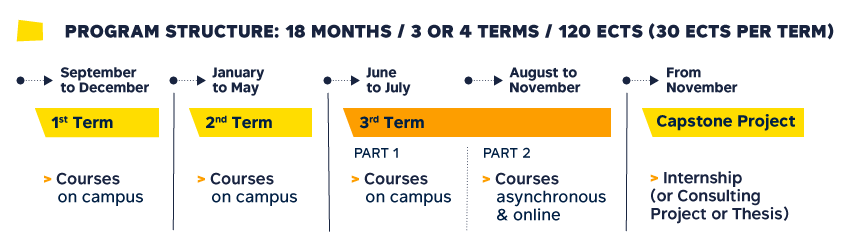
The program is offered on a full-time basis and consists of two (fast track) or three (regular track) academic semesters followed by an internship or master thesis semester. The academic semesters are developed around core courses in business, technology, and methodology in the field of AI and data analytics.
All academic semesters are on premise, except the second part of the third semester of the regular track which starts in August and is delivered in an asynchronous mode. This allows participants to start their internship or master thesis semester in early September.
In a connected world, data provides companies with the opportunity to align their decision-making strategy with objective facts and figures. Participants will learn how to become data scientists, and will be able to spot analytical opportunities for a given business context.
Program structure
IÉSEG’s Master in AI & Data Analytics for Business is designed for students who are eager to live a multicultural and international experience, and offers two different tracks based on participants’ academic background:
> Fast Track: Participants who have 4 years of higher education (4-year Bachelor, Master or “M1” validated by an official degree equivalent to at least 240 ECTS credits) may request exemption from the 3rd term.
> Regular Track: for all participants. Mandatory for participants who have 3 years of higher education (3-year Bachelor, Licence/ “Bac+3”) validated by an official degree equivalent to 180 ECTS credits.
> IÉSEG reserves the right to admit candidates with a 4-year degree into the Regular Track depending on the quality of their application.
> Due to a bilateral agreement between India and France, Indian students are required to take the Regular Track, regardless of the length of the Bachelor’s degree obtained.
Course Content
The program is offered on a full-time basis and consists of two (fast track) or three (regular track) academic semesters followed by an internship or master thesis semester.
ECTS

This course introduces the participants to the field of AI and data analytics for business from a strategic angle.
Various case studies are exposed to the participants to let them critically reflect how AI and data science might deliver added value for companies across different industries.
This course gives insight into the various real-life aspects of AI solutions and data analytics.
Real-life case studies are presented to reveal best practices for AI and data analytics. At the end of the course, participants have a better view on spotting AI opportunities in business.
The objective of this course is to introduce participants to data visualization using Tableau.
The participants will see the best practices of data visualization, learn how to make compelling dashboards, and perform visual analytics using Tableau.
The objective of this course is to introduce participants to Python programming.
At the end of this course, participants are fluent in advanced Python programming.
This course covers the concepts of relational databases and the industry standard of Structured Query Language (SQL).
This course gives the participants the ability to extract relevant information for AI and data analytics from databases using SQL.
In this course, participants are introduced to the foundational principles of descriptive and predictive analytics.
They learn essential techniques for analyzing historical data to understand past events and are acquainted with the basic concepts of predictive analytics for predicting future outcomes.
Coming soon.
The Career Program aims to help IÉSEG students build and implement their professional objective in line with their aspirations, skills and the socio-economic reality of the market.
The objective is to facilitate their integration into the labor market, in an environment that allows them to develop personally and professionally
All students benefit from a credited program tailored to their track or major, taught by a dedicated team of experienced professionals. The Career Program includes collective credit courses, digital resources, and on-demand coaching provided by the Career team for those who need additional support.
A cycle of thematic events fosters connections with companies and helps students build their professional networks. Our pedagogical approach blends various teaching methods, including digital modules, interactive and blended learning, coaching, peer-to-peer, learning by doing, live scenarios, debriefing, and reflection, in line with IÉSEG’s teaching and learning strategy.
Credited Language courses for all levels are included in the program.
French is the mandatory choice for any non-French speaking student. For native French speaking students, other languages are offered (Chinese, Spanish, German – list subject to change).
This course introduces participants to the most popular commercial data & AI technologies.
Participants learn about the advantages and disadvantages of using these commercial software packages. Most of the attention goes to the acquisition of relevant skills that will enable participants to flourish in a data-driven environment and understand how to create value using AI.
This course centers around big data processing and storage and introduces cloud platforms and streaming.
Participants are exposed to leading concepts and technologies in big data such as Spark and Hadoop.
This course introduces the participants to various statistical and machine learning algorithms for AI development.
This is a fundamental course in the curriculum as it delivers theoretical and hands-on experience in applying basic to state-of-the-art algorithms on various prediction problems.
This course delves into the essential techniques for forecasting future trends and patterns based on historical data using time-series analysis.
Participants will gain the expertise to make informed decisions across industries based on the forecasted outputs.
This course delivers the participants a unique and hands-on experience of solving a real-life AI and data science challenge for a company.
The participants work in teams in a four-month hackathon project to deliver an AI and data-driven solution that is acceptable to both the data scientists and the business managers. The supporting staff is composed of both academic and company supervisors.
Coming soon.
The Career Program aims to help IÉSEG students build and implement their professional objective in line with their aspirations, skills and the socio-economic reality of the market.
The objective is to facilitate their integration into the labor market, in an environment that allows them to develop personally and professionally
All students benefit from a credited program tailored to their track or major, taught by a dedicated team of experienced professionals. The Career Program includes collective credit courses, digital resources, and on-demand coaching provided by the Career team for those who need additional support.
A cycle of thematic events fosters connections with companies and helps students build their professional networks. Our pedagogical approach blends various teaching methods, including digital modules, interactive and blended learning, coaching, peer-to-peer, learning by doing, live scenarios, debriefing, and reflection, in line with IÉSEG’s teaching and learning strategy.
Credited Language courses for all levels are included in the program.
French is the mandatory choice for any non-French speaking student. For native French speaking students, other languages are offered (Chinese, Spanish, German – list subject to change).
This course covers how to leverage company data and AI to create value and to build a competitive advantage.
At the end of the course, participants can understand and manage the data lifecycle and implement a data strategy for a given company setting.
The course tackles the basic principles of the project management field. Project management is a managerial discipline that is inevitable in an AI and data-driven business contexts nowadays.
In multiple industries as diverse as retail, financial services, pharmaceuticals, software and aerospace, AI projects drive business. Effective project management often translates into gleaming new opportunities that often translate into increased sales.
This course provides an applied perspective on mathematical programming (MP), instead of focusing on algorithms.
In particular, it serves 3 purposes: (i) providing a selective catalogue of practical MP problems faced by managers, (ii) linking these problems to the different types of mathematical optimization methods, (iii) formulating MP problems and interpreting their solutions within a spreadsheet.
In this course, the participant learns about the design of recommender systems: the underlying concepts, design space, and trade-offs.
A participant should understand the design space of recommender systems and be able to provide design recommendations for a particular application domain, as well as critique a design to point out its strengths and weaknesses.
This course introduces how network data delivers value in business decision making.
At the end of the course, participants can scrutinize network data, build a (social) network, and draw relevant conclusions that support AI and data-driven solutions.
This course provides participants with a profound understanding of entrepreneurship, new business development, and business plan writing.
Through lectures, testimonials, fieldwork, and group assignments, participants are confronted with the how, where, when, whom, and why of starting and developing new business activities. As part of an international and multicultural team, participants are invited to work on an operational business plan aimed at either the creation of a new venture (NVC-track) or the acceleration of new business for an already established SME (NBD-track).
This course’s ambitions thus go beyond providing theoretical insights. Hands-on experience is gained through out-of-class field work covering all steps of the entrepreneurial decision-making process (e.g., idea generation, feasibility analysis, industry study, market analysis, marketing plan, production plan, product development, and financial statements).
In doing so, participants accumulate entrepreneurial knowledge and behaviors that support innovative solutions and new value development.
This course equips students with analytical tools and a strategic perspective to understand how geopolitical dynamics impact global business environments.
Through an interdisciplinary approach, students explore the influence of political risk, international relations, and global power shifts on trade, investment, supply chains, and corporate strategy. Emphasis is placed on real-world cases and interactive discussions to help students assess geopolitical risk and adapt business decisions accordingly.
By the end of the course, participants will be able to integrate geopolitical thinking into strategic planning, enabling responsible and resilient decision-making in complex international contexts. Participants will also be able to integrate geopolitical thinking into strategic planning, enabling responsible and resilient decision-making in complex international contexts.
Particular attention is given to the social impact of geopolitical shifts, encouraging students to consider how business decisions can promote inclusive growth, ethical practices, and long-term societal resilience.
This is a modular, asynchronous course designed to provide participants with a comprehensive and integrated understanding of AI and its transformative impact on business strategy.
Bridging technical knowledge and strategic insight, the course guides learners through a rich curriculum that explores how AI drives innovation, enhances operational efficiency, and creates sustainable competitive advantages.
The learning journey culminates in real-world case studies that demonstrate how leading organizations have successfully integrated AI into their strategies, operations, and innovation processes. These examples provide actionable insights and help bridge theory with practical application.
Crucially, the course also engages with the broader societal and environmental impacts of AI, positioning ethical, ecological, and workforce considerations as central to strategic decision-making. By the end of the course, participants will not only understand how AI works, but also how to deploy it responsibly and strategically for long-term business success in complex, dynamic environments.
Creativity is one of the critical components of an organization’s ability to survive and thrive in today’s competitive and dynamic markets. This course will provide participants with a rich understanding of how creativity can be facilitated and managed in a work setting.
They will acquire knowledge regarding various theoretical conceptualizations (i.e., how do you define creativity), antecedents (i.e., what makes you and others more creative) and outcomes (i.e., what is the impact) of creativity as well as knowledge on design thinking techniques and tools to lead teams in the creative journey.
How do creative ideas happen? How can we foster our creativity and the creativity of those around us? What are the paths of creative development of individuals who are successful in their creative endeavours? What are the implications for fostering and managing creativity in the workplace? What are the obstacles to creativity? What is the nature of creativity in teams and organizations? These are some of the questions we will address.
During the course, a variety of teaching and learning techniques (including design thinking) will be used to enable participants to think critically and imaginatively about various perspectives of creativity. To realize the goal of a shared learning experience between participants and the instructor, the course is aimed at integrating real challenges and practical experiences of creativity, projects, presentations, experiential exercises, and critical reflection on the various course materials.
This advanced course provides a comprehensive exploration of how organizations can effectively manage, measure, and align performance at individual, team, and organizational levels.
The course begins by clarifying the concept of performance management – what it is, what it is not, and what characterizes effective strategic performance practices. Students will examine the challenges of defining and measuring performance accurately, and how to align performance indicators with broader strategic goals such as employee engagement, retention, and organizational growth.
Throughout the course, students will engage with a range of human resource management tools applicable at various stages of the performance management cycle. Legal, ethical, and reporting considerations—as well as software solutions—will also be addressed to provide a holistic understanding of modern performance systems.
A key focus of the course is the social dimension of performance management. Students will explore how to design systems that are valid, reliable, and fair for all employees, with a strong emphasis on eliminating bias and supporting diversity, inclusion, and social justice.
The course encourages critical assessment of whether performance systems genuinely enable all individuals, regardless of background, to demonstrate their full potential. This includes addressing how organizational culture, leadership behaviors, and system design can unintentionally disadvantage certain groups—and how such challenges can be effectively mitigated in practice.
Credited Language courses for all levels are included in the program.
French is the mandatory choice for any non-French speaking student. For native French speaking students, other languages are offered (Chinese, Spanish, German – list subject to change).
4-to 6-month internship or work experience anywhere in the world. Alternatively, students can opt for a consulting project or a thesis.
Please note that courses are subject to change; please check with the local contact if you have any questions.
Recognized professional certifications
To give its students a competitive edge on the professional market, this program not only prepares them to master data analysis and artificial intelligence to solve complex business challenges, but also offers the opportunity to earn recognized professional certifications in key areas.
Examples:
> Programming languages (Python, SQL)
> Visual analytics (Tableau)
> Cloud solutions (Amazon Web Services)
> Data science methods (Datacamp and Bluecourses)

Zoom on… a kick-start into the professional career
The Master in AI & Data Analytics for Business offers its participants a real-life consulting challenge during the second semester. This project aims to put the competences and skills absorbed over the academic year into practice. In collaboration with a company, participants solve real business problems using the various technologies and methods that they have acquired.The project is organized in the form of a four-month data science hackathon. Previous supporting companies are Microsoft, Graydon, Mealhero, Delaware Consulting, Oney, Cofidis, Crédit Agricole, Port of Antwerp-Bruges, The Royal Belgian Soccer Association, Enfocus, Mobly, Monabanq, Cinionic, Austrian National Bank, Bleckmann and many others.More information about the Hackathon

Workshops and Corporate Events
Alongside the courses, the program includes various workshops and corporate events to further develop your personal and professional skills. These cover a range of topics, such as conflict management in cross-cultural environments and intercultural communication.
Our Career Program helps participants to establish their professional career plan by working on their skills, personal strengths, and using networking tools to be prepared to meet recruiters’ expectations internationally.
INTERNSHIP
During their internship, students are able to combine theories of management with hands-on experience and apply the cross-cultural skills they have developed at IÉSEG.
Big Data Engineer, Customer Data Analyst, Data Analyst, Data Architect, Data Quality Engineer, Data Science Researcher, Data Scientist, Online Marketing Analyst, Performance Analyst or Pricing Intelligence Analyst for example: the internship opportunities offered by the program at the end of the curriculum are multiple.
Some companies which hire our interns: Trivago, Accenture, Teradata, Honda Europe, Bombardier, KBC, Materialise, Pipecandy, McAfee, CapGemini, Allianz, Sodexo, BNP Paribas, Bloomon, Auchan, AXA, etc.
The internship can be undertaken in France or abroad. Most students have done their internships in Europe or in Asia for example.
Corporate Involment in this program
Companies are an integral part of the academic life of this Specialized Master. Throughout the program, participants have the opportunity to meet and network with companies of all sizes on topics related to the master, such as conferences, in-class interventions, challenges or tailor-made recruitment. Partnerships may vary from one to another and new opportunities may be proposed according to needs and availability.
Examples of previous events organized:
> Company visit: “Design Thinking workshop and visit of the innovation lab” – CAPGEMINI
> In-class intervention – PALANTIR TECHNOLOGIES – L’ORÉAL
> Conference “Leading with data in organizations” – SAEGUS – PWC – BROTHER FRANCE

Local contact
Find here your dedicated contact in your region.

