
3 Terms + Capstone Project
Master in Fashion Management Program
Premium preparation for your career in fashion and luxury.
-

-

English
-

Paris – France
-

€28,300 (Fast Track) / €31,300 (Regular Track)
-

September
-

120 ECTS
Accreditations


Curriculum
The Master in Fashion Management is the perfect program to specialize in Fashion and Luxury management.
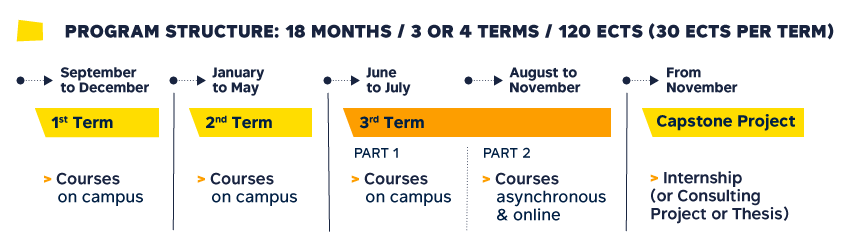
The program is offered on a full-time basis and consists of two (fast track) or three (regular track) academic semesters followed by an internship or master thesis semester. The curriculum is developed around introductory courses to build a common managerial background; core management courses; and specialized courses in fashion and luxury. The second part of the third semester will be delivered in an asynchronous mode so students can start their capstone project in early September of the second academic year.
Our students benefit from a dedicated faculty with extensive experience and knowledge of the industry. There are collaborations with many companies and professionals operating in the fashion industry, from luxury to fast fashion retailers. Companies are involved in the program through guest lectures, Masterclasses, internships/jobs, recruitment seminars and flagship stores visits.
Courses will be a mix of interactive lectures and traditional classes; guest speakers from the academic and fashion business community; corporate visits and seminars; and problem-based learning cases.
Program structure
IÉSEG’s Master in Fashion Management is designed for students who are eager to live a multicultural and international experience, and offers two different tracks based on participants’ academic background:
> Fast Track: Participants who have 4 years of higher education (4-year Bachelor, Master or “M1” validated by an official degree equivalent to at least 240 ECTS credits) may request exemption from the 3rd term.
> Regular Track: for all participants. Mandatory for participants who have 3 years of higher education (Bachelor in 3 years, Licence/”Bac+3″) validated by an official degree with the equivalent of 180 ECTS credits.
> IÉSEG reserves the right to admit candidates with a 4-year degree into the Regular Track depending on the quality of their application.
> Due to a bilateral agreement between India and France, Indian students are required to take the Regular Track, regardless of the length of the Bachelor’s degree obtained.
Course Content
ECTS

This course introduces accounting principles from a business perspective, focusing on how financial information is created, interpreted, and used for decision-making. Students will learn how accounting supports managers, investors, and analysts by evaluating performance, assessing alternatives, and guiding strategic business choices.
This course examines how luxury organizations are strategically designed to thrive in dynamic, experience-driven industries. Students will explore the global luxury market, organizational structures, and the drivers of creativity and innovation, gaining the tools to build agile, strategically aligned, and innovative organizations.
The objective of this course is to understand the new challenges that marketing teams face in fashion companies, more specifically:
Sector key figures, and marketing challenges and opportunities in fashion & luxury
Experience and product management strategy for fashion & luxury brands
Customers and their behavior when purchasing fashion & luxury brands
Innovation and communication in fashion & luxury companies
By the end of the course, students will understand key marketing theories and influence strategies and how they apply to fashion and luxury management. They will be able to develop a marketing plan, apply strategic marketing concepts, and perform both strategic and operational marketing analyses.
This course explores how luxury brands create identity, cultural relevance, and influence across diverse luxury industries. Through an immersion into sectors such as champagne, perfumes, and other luxury categories, students will examine the roles of prestige, heritage, and innovation in building enduring brand value and differentiation. The course provides insights into the strategies that enable brands to evolve from premium offerings into truly iconic luxury maisons.
The class focuses on managing events and organizing fashion shows. It covers:
Managing events in luxury
History and evolution of fashion shows
Today’s context of fashion shows: general structure of fashion weeks and cultural specificities
The secrets of backstage (understanding how a show is produced, and who the different players are)
Production companies and model agencies
Key success factors and challenges: creating and planning events
From diversity to inclusivity
At the end of the course, students will be able to understand and define the various aspects of business strategy in the fashion and luxury industry. They should be able to explore the competitive forces of the market environment and examine the internal issues of the organization that determine upcoming trends in this industry. This should allow them to examine and evaluate analytically, without overlooking details, the formulation of the firm’s long-term strategy.
This course explores the key concepts and challenges of international supply chains and logistics, with a focus on the fashion and luxury industries. Students will learn how to design resilient, sustainable, and efficient supply chains while understanding the impact of digitalization on their optimization and management.
This course introduces the fundamentals of pattern making and cutting, guiding students through the transformation of design concepts into wearable garments. Students will learn to create basic and advanced patterns, understand fabric behavior, and select appropriate materials based on texture, drape, and construction needs.
This course traces the evolution of fashion in the 20th century, after an introduction to the history of costume.
Clothing, accessories, textiles, hair and make-up, production, distribution and acquisition are analyzed through art, literature and other primary sources. Students will learn about the principal contributions made by famous designers to the world of fashion, and will study in depth how each designer was influenced by contemporary events and the world of art.
This course introduces students to the fundamental characteristics, properties, and applications of natural and synthetic fabrics used in the fashion industry. Through the study of textile fibers, weaves, and finishes, students develop the knowledge needed to make informed design, sourcing, and product development decisions.
This course provides students with the knowledge and critical perspectives needed to address the sustainability and ethical challenges facing organizations in a rapidly changing global environment.
The first part of the course introduces major sustainability issues affecting businesses, including:
Climate change
Biodiversity loss
Social justice
Labor conditions
Global supply chains
Students explore key concepts, frameworks, tools, and standards for assessing environmental, social, and governance (ESG) impacts, and how organizations can rethink their strategies and redesign their business models to support sustainability transitions. Throughout the course, they reflect critically on ecological limits, stakeholder responsibilities, and the ethical role of business in advancing sustainable development.
The second part of the course is devoted to program-specific applications tailored to the needs of each master’s program.
By the end of the course, students will be able to critically evaluate sustainability and ethical challenges, apply relevant ESG frameworks and ethical reasoning to organizational decision-making, and propose practical solutions that contribute to sustainable business practices.
Credited language courses for all levels are included in the program. French is mandatory for all non-French-speaking students.
Native French-speaking students can choose another language (Chinese, Spanish, German; list subject to change).
The contemporary convergence of art, design and lifestyle is becoming a new frontier of fashion, often underground and yet to be deciphered, where tomorrow’s trends find fertile ground.
Designing a strategy and managing its processes in fashion means, first of all, recognizing and interpreting the signals, explicit and implicit, coming from international markets, in order to build a clear and convincing proposition: an individual and collective experience, a close dialogue between the brand and the individual.
Through the study of fashion branding processes, related to product design, communication, service and above all distribution, students will develop a detailed strategy aimed at strengthening a brand. Numerous successful international case studies will help them codify the processes through which a brand concretely acquires uniqueness and charisma. The course invites each participant to build a 360° brand-strengthening strategy in a specific fashion context.
By the end of the course, students will be able to distinguish between different types of firms in the fashion and luxury sector and understand how budgeting, financing, and investment decisions impact firm value. They will also gain practical skills in applying corporate finance tools to support strategic decision-making within luxury businesses.
The course lays the foundations for students to understand how to create and sustain a competitive advantage through digitalization, by acting on the key drivers of such advantage in the specific context of the luxury industry.
In particular, it focuses on the internal challenges that digitalization brings to organizations in fashion, including the latest technological and organizational tools that allow them to fully digitize their business processes, their products, and their business models.
The course also provides a critical view of the digital innovation trend, allowing students to understand and discuss the disruptive effects of IT at both the individual and organizational levels.
This course explores team dynamics, leadership and organizational culture within the luxury industry, emphasizing emotional intelligence, influence, and decision-making. It focuses on the key drivers of customer experience and the skills required to manage a store as a successful business unit in today’s retail environment.
Students will develop emotional intelligence, communication, and leadership capabilities to effectively motivate and manage diverse teams. Through practical exercises, they will also strengthen their negotiation skills and learn how to create value in team interactions and decision-making.
This course explores the principles of communication management and event planning within the luxury and fashion industries. Students learn how to design and manage impactful events and communication strategies that strengthen brand identity and engage target audiences.
This course aims to give students a clear understanding of the global cosmetics and fragrance industry, including the cosmetic products industry, its brands and its products. They will learn about the different product categories, the legal framework, and the main trends, brands and innovations.
Students will explore the fundamental processes and timelines that shape the fashion system, gaining insight into the roles of key industry players. They will study past, present, and future fashion trends, learning how trends emerge and influence product development.
Through a creative, discussion-based approach with group projects and brainstorming sessions, students will analyze the connections between fashion trends and broader social, political, and economic contexts.
This course explores the unique dynamics of the fashion industry, brand typologies, and the full product development process. By the end, students will:
Gain a clear understanding of the fashion market and brand positioning
Analyze how creativity is applied to fashion and luxury product design
Learn how various organizations manage product development and design processes
Understand the fashion value chain, with emphasis on production and sourcing
Acquire foundational knowledge of fabric sourcing, supplier management, manufacturing techniques, supply chain, and related information systems
This course introduces the principles and strategies of fashion merchandising, focusing on product planning, assortment development, pricing, and retail performance. Students learn how to align consumer demand with business objectives to create successful and profitable product offerings.
Students will learn the difference between collection merchandising (the creative part of merchandising, focused on the product and on technical knowledge) and retail merchandising (technical management tools, the merchandise plan and open to buy, and how to link them correctly).
They will also understand the pivotal role of the fashion buyer in fashion retail, and more precisely as a key stakeholder in the fashion buying value chain.
By the end of the course, students should be able to link the merchandise plan logically to the range plan, while building a balanced collection of branded or private-label apparel.
The course aims to show students the sign and perceptual values (marketing-oriented) of communication and its visual representation, to help them choose the best solution when creating and representing products and services, and to sharpen their critical approach and design.
By the end of the course, students should be able to decide which signs, codes and communication strategies are best suited to designing and communicating according to the perceptual effects to be achieved, so as to give their communication the iconic or symbolic values most likely to arouse the end user’s desire to purchase.
They will thus understand that semiomarketing is the fast track to optimizing the target-client conversion rate and customer loyalty.
This course offers an in-depth exploration of luxury retail experiences and visual merchandising as essential drivers of brand value and customer engagement. Students will discover how luxury brands craft exceptional retail and client experiences across both physical and digital touchpoints, examining the interplay between heritage and innovation in creating seamless omnichannel strategies.
The course explores how personalized service, storytelling, and immersive brand environments elevate the customer journey and strengthen brand identity. Particular emphasis is placed on visual merchandising (VM) as a strategic tool that connects brand, product, and consumer experiences across online and offline channels.
Through a combination of theoretical frameworks, case studies, and practical exercises, students will examine the history and evolution of visual merchandising, including:
Window and interior design
Product presentation techniques
Experiential retail concepts
The course also highlights how VM supports broader corporate strategies, enhances customer engagement, and creates career opportunities within the luxury and retail industries.
This course equips students with the knowledge and skills required to investigate complex organizational challenges through rigorous research methods. Students learn to identify and analyze business problems, select and apply appropriate research methodologies, and critically engage with academic and professional sources to build robust, evidence-based knowledge.
Emphasis is placed on developing creative solutions to organizational issues and communicating research findings effectively through clear, persuasive, and professional presentation techniques. The course combines a common foundation in research methods with program-specific applications that reflect the research needs and practices of each master’s program.
By the end of the course, students will be able to design and conduct methodologically sound research that supports informed decision-making in organizational and business contexts.
The Career Program aims to help IÉSEG students build and implement their career plan in line with their aspirations, skills and the socio-economic reality of the market.
The objective is to facilitate their integration into the job market, in an environment that allows them to develop personally and professionally.
All students benefit from a credited program tailored to their track or major, taught by a dedicated team of experienced professionals. The Career Program includes collective credited courses, digital resources, and on-demand coaching provided by the Career team for those who need additional support.
A cycle of thematic events fosters connections with companies and helps students build their professional networks. Our teaching approach blends various methods, including digital modules, interactive and blended learning, coaching, peer-to-peer learning, learning by doing, live scenarios, debriefing, and reflection, in line with IÉSEG’s teaching and learning strategy.
Credited language courses for all levels are included in the program. French is mandatory for all non-French-speaking students.
Native French-speaking students can choose another language (Chinese, Spanish, German; list subject to change).
This course explores the digital transformation of the fashion and luxury market, from shifting consumer behaviors to the rise of e-commerce and mobile marketing. Students will learn to use strategic tools tailored to the luxury sector, such as POEMS, social media, SEO, and CRM. The course also covers emerging technologies such as AR, AI, and omnichannel retail that are shaping the future of luxury experiences.
The Digital Transformation in Fashion and Luxury course gives master’s students a comprehensive understanding of the emerging trends and technologies that are revolutionizing the fashion and luxury industry. Students will explore transformative concepts such as gamification, the metaverse (including VR/AR), blockchain (including NFTs) and generative AI, gaining insights into their profound implications for fashion and luxury brand strategies.
This course explores consumer behavior through the analysis of decision-making processes, including attitudes, behaviors, and the evaluation of alternatives. Students will examine how perception, learning, memory, identity, personality, and lifestyle influence consumer choices. The course also investigates the role of social influence, status, and cultural dynamics in shaping consumer experiences and behaviors.
These are some of the topics students will explore during this course:
What is the law related to fashion?
How to protect your fashion creations, innovations and brands?
Some legal issues related to the manufacture and trade of fashion products
This course equips students with the knowledge and skills required to investigate complex organizational challenges through rigorous research methods. Students learn to identify and analyze business problems, select and apply appropriate research methodologies, and critically engage with academic and professional sources to build robust, evidence-based knowledge.
Emphasis is placed on developing creative solutions to organizational issues and communicating research findings effectively through clear, persuasive, and professional presentation techniques. The course combines a common foundation in research methods with program-specific applications that reflect the research needs and practices of each master’s program.
By the end of the course, students will be able to design and conduct methodologically sound research that supports informed decision-making in organizational and business contexts.
This course gives participants an in-depth understanding of entrepreneurship, new business development, and business plan writing.
Through lectures, testimonials, fieldwork, and group assignments, participants are confronted with the how, where, when, with whom, and why of starting and developing new business activities.
As part of an international and multicultural team, participants work on an operational business plan with one of two aims:
The creation of a new venture (NVC track)
The acceleration of new business for an already established SME (NBD track)
The course thus goes beyond theory: hands-on experience is gained through out-of-class fieldwork covering all steps of the entrepreneurial decision-making process, for example idea generation, feasibility analysis, industry study, market analysis, marketing plan, production plan, product development, and financial statements.
In doing so, participants acquire entrepreneurial knowledge and behaviors that support innovative solutions and new value creation.
This course equips students with the analytical tools and strategic perspective to understand how geopolitical dynamics impact global business environments. Through an interdisciplinary approach, students explore the influence of political risk, international relations, and global power shifts on trade, investment, supply chains, and corporate strategy.
Emphasis is placed on real-world cases and interactive discussions to help students assess geopolitical risk and adapt business decisions accordingly. By the end of the course, participants will be able to integrate geopolitical thinking into strategic planning, enabling responsible and resilient decision-making in complex international contexts.
Particular attention is given to the social impact of geopolitical shifts, encouraging students to consider how business decisions can promote inclusive growth, ethical practices, and long-term societal resilience.
This is a modular, asynchronous course designed to give participants a comprehensive and integrated understanding of AI and its transformative impact on business strategy. Bridging technical knowledge and strategic insight, the course guides learners through a rich curriculum that explores how AI drives innovation, enhances operational efficiency, and creates sustainable competitive advantages.
The learning journey culminates in real-world case studies that demonstrate how leading organizations have successfully integrated AI into their strategies, operations, and innovation processes. These examples provide actionable insights and help bridge theory and practice.
Crucially, the course also addresses the broader societal and environmental impacts of AI, placing ethical, ecological, and workforce considerations at the heart of strategic decision-making. By the end of the course, participants will understand not only how AI works, but also how to deploy it responsibly and strategically for long-term business success in complex, dynamic environments.
Creativity is one of the critical components of an organization’s ability to survive and thrive in today’s competitive and dynamic markets. This course gives participants a rich understanding of how creativity can be fostered and managed in a work setting.
They will acquire knowledge of the various theoretical conceptualizations of creativity (how to define it), its antecedents (what makes you and others more creative) and its outcomes (what impact it has), as well as of design thinking techniques and tools to lead teams through the creative journey.
Here are some of the questions we will address:
How do creative ideas happen?
How can we foster our creativity and the creativity of those around us?
What are the paths of creative development of individuals who succeed in their creative endeavors?
What are the implications for fostering and managing creativity in the workplace?
What are the obstacles to creativity?
What is the nature of creativity in teams and organizations?
During the course, a variety of teaching and learning techniques (including design thinking) will be used to help participants think critically and imaginatively about different perspectives on creativity.
To make learning a shared experience between participants and the instructor, the course integrates real challenges and practical experiences of creativity: projects, presentations, experiential exercises, and critical reflection on the course materials.
This advanced course offers a comprehensive exploration of how organizations can effectively manage, measure, and align performance at individual, team, and organizational levels. It begins by clarifying the concept of performance management: what it is, what it is not, and what characterizes effective strategic performance practices.
Students will examine the challenges of defining and measuring performance accurately, and how to align performance indicators with broader strategic goals such as employee engagement, retention, and organizational growth. Throughout the course, they will work with a range of human resource management tools applicable at the various stages of the performance management cycle. Legal, ethical, and reporting considerations, as well as software solutions, are also addressed to provide a holistic understanding of modern performance systems.
A key focus of the course is the social dimension of performance management. Students will explore how to design systems that are valid, reliable, and fair for all employees, with a strong emphasis on eliminating bias and supporting diversity, inclusion, and social justice.
The course encourages critical assessment of whether performance systems genuinely enable all individuals, regardless of background, to demonstrate their full potential. This includes addressing how organizational culture, leadership behaviors, and system design can unintentionally disadvantage certain groups, and how such challenges can be effectively mitigated in practice.
Credited language courses for all levels are included in the program. French is mandatory for all non-French-speaking students.
Native French-speaking students can choose another language (Chinese, Spanish, German; list subject to change).
4- to 6-month internship or work experience anywhere in the world. Alternatively, students can opt for a consulting project or a thesis.
Please note that courses are subject to change; please check with the local contact if you have any questions.

Zoom on… company visits
Over the year students have the opportunity to do several visits and attend events related to the luxury industry. Previous visits included: Galerie Dior, Vuitton (LV Dream), 19M (Chanel and École Lesage), Musées des Arts Décoratifs. Fondation Azzedine Alaïa, Musee Yves Saint Laurent, among others. They also visited iconic places of fashion shows and attended prestigious fairs, such as Premiere Vision.

Workshops and Corporate Events
Alongside the courses, the program includes additional workshops and corporate events to develop participants’ personal and professional skills further. These cover a range of topics such as conflict management in cross-cultural environments and intercultural communication.
Our Talent program helps participants to establish their professional career plan by working on their skills, personal strengths, and using networking tools to be prepared to meet recruiters’ expectations internationally.

Partnerships

Partnership with Istituto Marangoni
Some of the courses offered during the Master in Fashion Management program are offered by faculty from Istituto Marangoni.
Istituto Marangoni was founded in 1935 in Milan as ‘Istituto Artistico dell’Abbigliamento Marangoni’, and has been a top educational choice for creatives in the worlds of fashion, art and design for over 85 years now. With four generations of students from 5 continents, it was the springboard for over 45,000 luxury professionals, including Domenico Dolce, Alessandro Sartori, Paula Cademartori, Gilda Ambrosio, Julie de Libran and Nicola Brognano.
Istituto Marangoni currently welcomes about 5.000 students from 108 different countries every year in its schools in the world capitals of fashion, art and design, including Milano, Firenze, Paris, London, Mumbai, Shanghai, Shenzhen Miami and Dubai. Istituto Marangoni is ranked among the 100 best universities in the world in its fields according to QS World University Ranking 2023.
Its educational offering, broad and articulated, consists of:
> Undergraduate Courses (Preparatory, One-year and BA (Hons) Degree = Three-Year),
> Postgraduate Courses (Preparatory and Master’s Degrees; Master’s Courses; Cycles de Spécialisation) and
> Short Courses.
For more information, visit www.istitutomarangoni.com
Corporate involvement in the program
Companies are an integral part of the academic life of this Specialized Master. Throughout the program, students have the opportunity to meet and network with companies of all sizes on topics related to the master, such as conferences, in-class interventions, challenges or tailor-made recruitment. Partnerships may vary from one to another and new opportunities may be proposed according to needs and availability.
Examples of previous events organized*:
> Company presentation – GUERLAIN – GUCCI – PUIG
> Company presentation and internships opportunities: – Christian Dior COUTURE – Parfums Christain Dior – Louis Vuitton
> Masterclass – CHRISTIAN LOUBOUTIN – MESSIKA – RALPH LAUREN
*Non-exhaustive list
A double degree opportunity for Grande Ecole students
IÉSEG students already enrolled in the Grande Ecole Program admitted in the Master in Fashion Management can obtain a double degree: the GE (Grandes Ecoles) and the Master in Fashion Management, by adding just a semester to the 5-years Master program.
To be admitted, students are expected to validate their first year Master (4th year – GE program), by having finished the two semesters of courses.
During their 5th-year, IÉSEG students will follow all the fashion courses listed in the program and some of the compulsory management courses/guest lectures. They will write the memoire/project consulting on a fashion management topic, and during the additional semester (first semester of the 6th year), they will undertake a 6 months internship in a fashion company.
Fee for the additional semester: 5000 euros

Local contact
Find here your dedicated contact in your region.

